



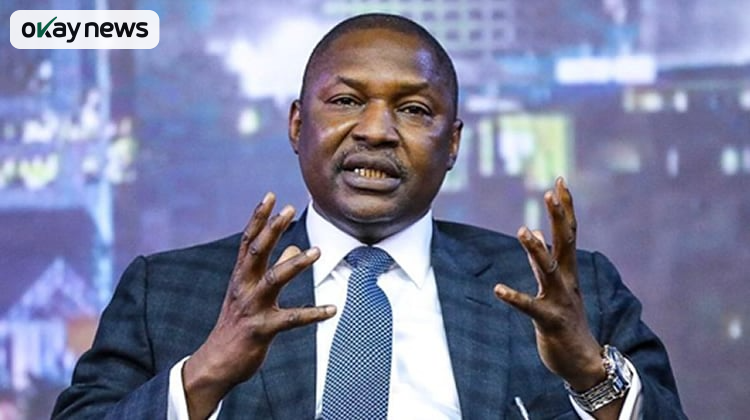
The Economic and Financial Crimes Commission (EFCC) of Nigeria has prepared to call bank representatives and Bureau De Change (BDC) operators as witnesses in alleged money laundering charges against former Attorney-General of the Federation and Minister of Justice Abubakar Malami, a Senior Advocate of Nigeria (SAN).
Okay News reports that court documents in charge FHC/ABJ/CR/700/2025 list about 10 categories of witnesses. They include unnamed officials from Zenith Bank Plc and Sterling Bank Plc, alongside BDC operators and EFCC investigators.
Malami faces 16 counts jointly with Hajia Bashir Asabe and Abubakar Abdulaziz Malami. Allegations involve contravening the Money Laundering Act with billions of naira.
Count one accuses Malami and Abdulaziz of procuring Metropolitan Auto Tech Limited to conceal N1,014,848,500 in Sterling Bank. Origins allegedly trace to unlawful activity.
Count 16 details property acquisitions worth N415 million as proceeds of crime. Assets include residences in Gwarimpa and Ipent 7 Estate in Abuja, Nigeria’s federal capital, plus commercial facilities in Birnin Kebbi, land along Birnin Kebbi–Jega Road, and a plot in Kano.
Charges cover procurement, conspiracy, concealment, and acquisition of unlawful proceeds. Allegations remain unproven until court verdict.
Malami’s office rejected the charges in a statement. It accused EFCC of “brazen, contemptuous, and lawless conduct”.
Spokesperson Mohammed Bello Doka cited a Federal Capital Territory High Court bail order on December 23, 2025. Conditions were met, but EFCC allegedly refused compliance and detained Malami over 14 days without arraignment.
The statement claimed violation of fundamental rights. A separate detention order expires, obligating release or charges.
Malami previously alleged EFCC intimidation linked to past judicial reports. The commission denied partisanship.
This case joins investigations of former officials from prior administrations. It highlights anti-corruption efforts targeting high-profile figures.
Charges underscore scrutiny of public office conduct. Outcomes await judicial proceedings in Nigeria’s federal courts.



 of Nigeria has prepared to call bank representatives and Bureau De Change (BDC) operators as witnesses in alleged money laundering charges against former Attorney-General of the Federation and Minister of Justice Abubakar Malami, a Senior Advocate of Nigeria (SAN).)