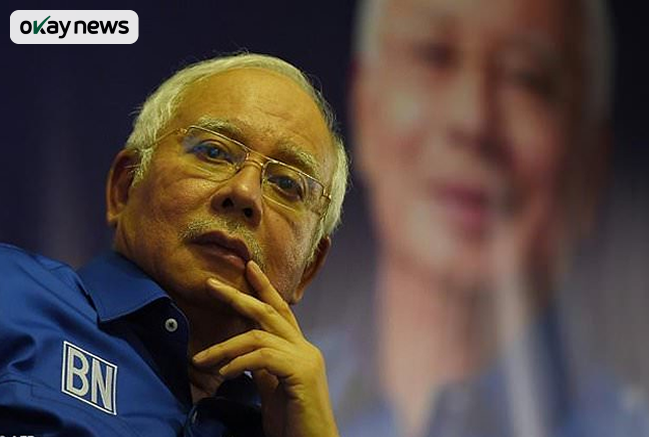
A Malaysian High Court on Friday convicted Najib Razak, a former Prime Minister of Malaysia, over extensive corruption linked to the 1Malaysia Development Berhad sovereign wealth fund, marking another major legal setback for the once-powerful Southeast Asian leader.
Okay News reports that the Kuala Lumpur High Court found the 72-year-old politician guilty of abusing his official authority to siphon public funds and launder proceeds connected to the now-defunct state investment entity.
Presiding Judge Collin Lawrence Sequerah convicted Najib on all four counts of abuse of power and all 21 counts of money laundering. The charges involved approximately 2.28 billion Malaysian ringgit, equivalent to about $554 million, which prosecutors said were misappropriated from the fund.
Sentencing is expected later on Friday and could significantly extend Najib’s current six-year prison term, which he is already serving following a separate conviction tied to the same investment vehicle.
Inside the courtroom in Kuala Lumpur, the capital city of Malaysia, Najib appeared visibly subdued. Dressed in a navy blue suit and white shirt, the former leader sat slumped as the judge delivered the verdict.
Najib Razak, the son of Abdul Razak Hussein, Malaysia’s second Prime Minister and one of the nation’s founding political figures, had long been viewed as a political heir apparent. However, his career collapsed dramatically amid mounting public outrage over the 1MDB corruption scandal.
Following his electoral defeat in 2018, successive Malaysian governments intensified investigations that eventually implicated Najib and his wife, Rosmah Mansor, in multiple graft-related allegations.
Prosecutors told the court that Najib exploited his overlapping roles as Prime Minister of Malaysia, Minister of Finance, and chairman of the advisory board of 1Malaysia Development Berhad to move massive sums of money into his personal bank accounts more than ten years ago.
Investigators further revealed that proceeds from the diverted funds were allegedly used to purchase luxury real estate, a high-end yacht, and valuable artworks across several countries.
Delivering his ruling, Judge Sequerah dismissed the defence’s claim that Najib had been deceived by his former associate, Low Taek Jho, a Malaysian financier popularly known as Jho Low.
“The evidence clearly points to the fact that this was no coincidence but was evident of a relationship in which Jho Low operated as a proxy or agent of the accused with regard to the running of the affairs of 1MDB,” the judge said.
The court also rejected the argument that Najib had been “misled and duped” by 1MDB management and Jho Low, describing the claim as “unmeritorious”.
1Malaysia Development Berhad was established in 2009 shortly after Najib assumed office as Prime Minister. Although Jho Low held no official position, whistleblowers said he exerted considerable influence over the fund’s financial decisions.
Authorities estimate that more than $4.5 billion was misappropriated from 1MDB between 2009 and 2015 by fund officials and their associates. Jho Low, who is accused of playing a central role in the scheme, remains a fugitive.
Judge Sequerah also dismissed claims that donations from Middle Eastern benefactors accounted for the funds found in Najib’s accounts, calling the explanation “a tale that surpassed even those from the Arabian Nights”.
The prosecution relied on extensive evidence, including bank records, testimony from more than 50 witnesses, and numerous financial documents.
During closing arguments, Deputy Public Prosecutor Ahmad Akram Gharib described Najib as the ultimate authority behind the fraud.
“The accused wielded absolute financial, executive and political control,” he said.
Najib’s legal team has consistently maintained that he was unaware of the illicit activities surrounding the fund. His lawyer, Muhammad Shafee Abdullah, reiterated last week that his client “never got a fair trial”.
The scandal triggered international investigations spanning Singapore, Switzerland, and the United States of America, severely damaging Malaysia’s global reputation.
Although Najib has apologised for allowing the scandal to occur during his administration, he continues to deny any personal wrongdoing.
Earlier this week, Najib suffered another legal defeat after a court rejected his request to serve the remainder of his sentence under house arrest instead of at Kajang Prison, located outside Kuala Lumpur.
Each abuse of power charge carries a potential penalty of up to 20 years in prison and a fine of up to five times the value of the alleged bribe.