The Chairman of the Sokoto State Preventing and Countering Violent Extremism Committee, Muhammad Suraju, has cautioned that military operations alone cannot resolve the persistent insecurity affecting Nigeria’s Northwest region, stressing the need for inclusive governance, economic empowerment, and community-driven peace initiatives.
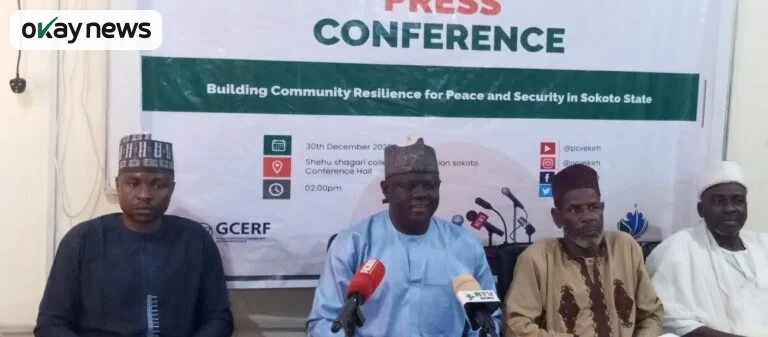
He made this known during a press conference held on Tuesday at the Shehu Shagari College of Education, located in Sokoto, the capital city of Sokoto State in northwestern Nigeria. The event brought together government officials, community leaders, civil society actors, and security stakeholders to assess recent developments in the region’s security landscape.
Okay News reports that Muhammad Suraju explained that the Northwest is grappling with complex and interconnected security challenges that go beyond armed violence, including banditry, emerging extremist groups, and deep-rooted socio-economic vulnerabilities that continue to destabilize local communities.
“The Northwest is dealing with more than armed violence. We are confronting long-term marginalisation, youth unemployment, weak governance structures and cultural vulnerabilities that extremist groups continue to exploit,” Suraju said.
According to the Sokoto State Preventing and Countering Violent Extremism leadership, emerging extremist factions such as Lakurawa have exploited governance gaps and economic hardship to recruit young people, particularly in forested border communities where state presence remains weak.
“These groups thrive where hope is absent,” the chairman noted, adding that ongoing insecurity has worsened poverty, disrupted livelihoods, displaced families, and weakened trust between citizens and public authorities across several local government areas in the region.
Despite these challenges, the committee disclosed that significant progress has been recorded in the past week through coordinated preventive measures implemented across the Northwest. These include multi-stakeholder workshops involving government officials, security agencies, traditional rulers, women groups, youth organisations, and civil society institutions.
The committee also highlighted community-led dialogues aimed at co-designing local action plans focused on youth education, early warning systems, and violence prevention, alongside increased political commitment from lawmakers and security leaders toward implementation and budgetary support for Preventing and Countering Violent Extremism programmes.
In addition, community resilience campaigns have been rolled out, focusing on peace education, tolerance promotion, conflict awareness, and countering extremist narratives at the grassroots level.
Suraju stated that community response has been encouraging, with residents increasingly showing interest in taking ownership of peacebuilding efforts. “We are seeing stronger trust, better collaboration and improved early warning mechanisms at the grassroots,” he said.
He further revealed that notable gains include the drafting of State and Local Action Plans, the establishment of technical working groups, alignment with Nigeria’s National Preventing and Countering Violent Extremism Framework, and the integration of related priorities into state budget proposals.
However, the committee acknowledged persistent obstacles, including the continued presence of armed groups, widespread youth unemployment, economic hardship, weak intelligence coordination in some local governments, and limited integration of Preventing and Countering Violent Extremism priorities across government sectors.
“These challenges are real, but they also present opportunities. If we invest in youth, strengthen local governance and build trust, we can break the cycle of violence,” the chairman stressed.
The committee urged residents to remain vigilant, reject extremist narratives, and actively support peace initiatives. Youth and women groups were encouraged to take leadership roles in inclusion and resilience campaigns, while local governments were called upon to embed Preventing and Countering Violent Extremism priorities into planning and budgeting processes.
“Peace is not the responsibility of government alone. It is the duty of every citizen. Together, we can protect our communities and build a future founded on peace, dignity and opportunity,” Suraju said.
The briefing comes amid ongoing security challenges affecting several parts of Nigeria.