



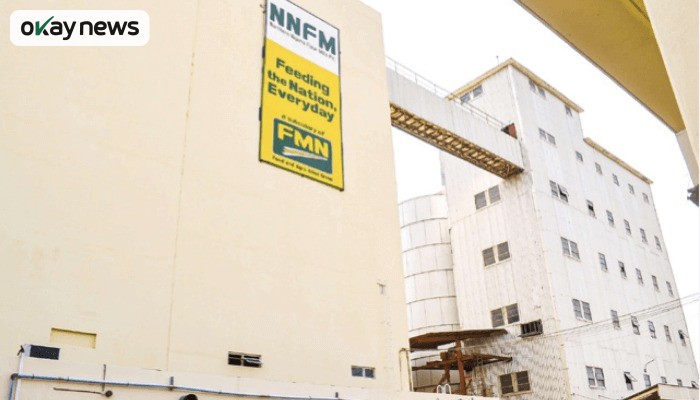
Northern Nigeria Flour Mills Plc (NNFM), a major Nigerian agribusiness and food processing company headquartered in Kano. Incorporated in 1971, the company specializes in milling local grains such as wheat, maize, and sorghum into popular household brands like Golden Penny Semovita and Masavita. It operates as a subsidiary of Flour Mills of Nigeria (FMN) Plc.
The company has reported a pre-tax loss of N584.87 million for the third quarter of 2026, ending December 31, 2025. This marks a sharp reversal from the N2.31 billion profit recorded during the same period in the 2025 financial year.
Okay News reports that the downturn was driven by a steep decline in revenue and a spike in finance costs. The report states: “The recovery extended into the fourth quarter, with pretax profit climbing 68.6% to N3.4 billion, up from N2.04 billion in the same quarter of 2024.”
Revenue Decline and Margin Compression
In Q3 2026, revenue dropped to N4.33 billion, representing a 48.8% decrease from N8.47 billion in the previous year. This slump, combined with high material costs, caused gross profit to fall 85.9% to N241.8 million.
The company also saw its “other operating income” turn negative at N254.1 million, compared to a contribution of over N1.1 billion in Q3 2025. This collapse in non-core income further eroded the company’s operating margins.
Surging Finance Costs
A major factor in the quarterly loss was the spike in finance costs, which rose to N181 million from just N19,000 in the prior year. Despite NNFM having no external borrowings, these costs are likely tied to lease-related financing or intra-group charges.
| Key Highlights (Q3 2026 vs Q3 2025) | Q3 2026 Value | Q3 2025 Value |
| Revenue | N4.33 Billion | N8.47 Billion |
| Gross Profit | N241.8 Million | N1.71 Billion |
| Finance Cost | N181 Million | N19 Thousand |
| Pre-tax Profit/Loss | (N584.9) Million Loss | N2.31 Billion Profit |
Balance Sheet and Market Position
Despite the earnings hit, NNFM’s total assets rose 18.3% to N31.97 billion, supported by higher inventories and receivables. Cash reserves also improved to N1.69 billion. However, equity dropped to N9.48 billion from N12.05 billion due to the decline in retained earnings.




 is a major Nigerian agribusiness and food processing company headquartered in Kano. Incorporated in 1971, the company specializes in milling local grains such as wheat, maize, and sorghum into popular household brands like Golden Penny Semovita and Masavita. It operates as a subsidiary of Flour Mills of Nigeria (FMN) Plc.)