Canada and France are opening new consulates in Nuuk, the capital of Greenland, on Friday, 6 February 2026, in a move widely seen as a strong sign of support for Greenland’s local authorities amid growing international attention on the Arctic territory.
Greenland is a vast, mineral-rich island in the Arctic that governs most of its internal affairs but remains part of the Kingdom of Denmark, a European country and a member of the North Atlantic Treaty Organization (NATO), the Western security alliance.
The step comes as the President of the United States, Donald Trump, continues to argue that Washington should have greater control over Greenland, saying the strategic island is important for security. The White House previously said on Monday, 6 January 2025, that Trump was considering options, including military action, to take control of Greenland, a stance that Denmark warned could seriously damage NATO unity.
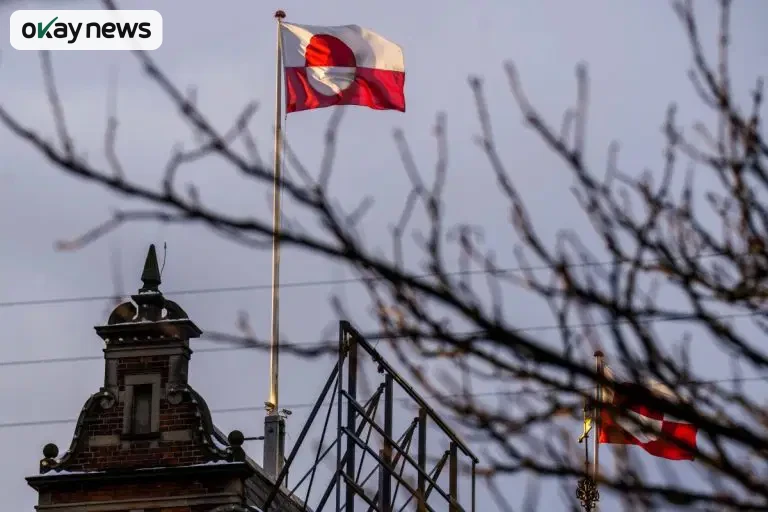
Okay News reports that a Greenlandic flag was seen flying on the roof of Tivoli Castle in Copenhagen, Denmark’s capital, on Wednesday, 8 January 2026, as the debate around Greenland’s future drew fresh attention across Europe and North America.
Since returning to the White House in 2025, Trump has repeatedly insisted that the United States needs control of the Arctic island because of its location and its natural resources. The United States president last month eased off earlier threats to seize Greenland after saying he had reached a “framework” arrangement with NATO Secretary-General Mark Rutte, the former Dutch prime minister who now leads the alliance, to ensure greater American influence.
A three-way working group involving the United States, Denmark, and Greenland has been set up to discuss ways to address Washington’s security concerns in the Arctic. However, the details of the talks have not been made public.
Denmark and Greenland have said they share concerns about security in the region, but they have also stressed that Greenland’s sovereignty and Denmark’s territorial integrity are a firm “red line” in any discussions.
Jeppe Strandsbjerg, a political scientist at the University of Greenland, said the opening of two new diplomatic offices in Nuuk signals growing international recognition for Greenland. He described it as “a victory for Greenlanders” to see allies setting up diplomatic representation in the capital, adding that there is strong appreciation locally for support against Trump’s statements.
France’s President, Emmanuel Macron, announced Paris’s plan to open a consulate during a visit to Nuuk in June, when he spoke about Europe’s solidarity with Greenland and criticised Trump’s ambitions over the island.
France’s newly appointed consul, Jean-Noel Poirier, previously served as France’s ambassador to Vietnam.
Canada, which has close Arctic interests of its own, announced in late 2024 that it would open a consulate in Greenland to strengthen cooperation.
Ulrik Pram Gad, an Arctic specialist at the Danish Institute for International Studies (DIIS), said the diplomatic moves are also meant to send a broader message beyond Greenland and Denmark. He said it is a way of telling Trump that pressure on Greenland and Denmark is not only their issue, but also a matter for European allies, and for Canada as an ally and friend of Greenland and Europe.
Christine Nissen, a security and defence analyst at the Europa think tank, said the new consulates are “a small step” within a wider effort to make the challenge a European issue. She added that the consequences of the situation are not only Danish, but European and global.
Analysts also say the decision has long-term meaning for Greenland’s political development. Strandsbjerg said the two consulates, which will be linked to the French and Canadian embassies in Copenhagen, could help Greenland “practice” operating more independently in international affairs, as many Greenlanders have long spoken about the possibility of loosening ties with Denmark in the future.
Nissen said the move also reflects Greenland’s expanding autonomy under its 2009 Self-Government Act, which transferred significant powers from Denmark to Greenland’s authorities and outlined a pathway for the island to take greater responsibility over its own governance.
She said that, as Greenland continues its quest for greater sovereignty, many Greenlanders will want more direct contact with other European countries. That, analysts say, can reduce Denmark’s role by expanding Greenland’s external relationships through trade, investment, politics, and wider cooperation with multiple partners.
Greenland has had formal links with the European Union (EU), the political and economic bloc of European states, since 1992. It has had diplomatic ties with Washington since 2014, and with Iceland since 2017.
Iceland opened a consulate in Nuuk in 2013. The United States previously operated a consulate in the Greenlandic capital from 1940 to 1953 and reopened its mission there in 2020. The European Commission, the executive arm of the EU, opened its office in Greenland in 2024.