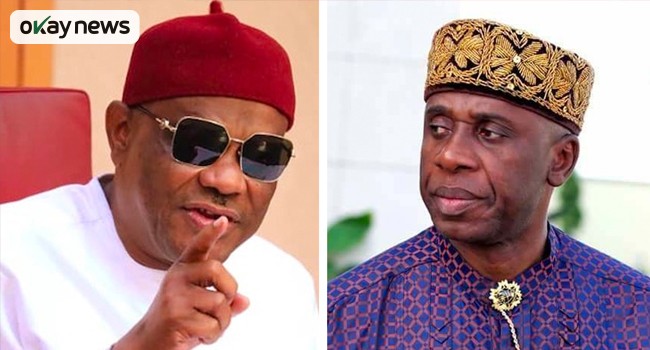
Nigeria’s Minister of the Federal Capital Territory, Nyesom Wike, has publicly criticised former Rivers State Governor and former Minister of Transportation, Rotimi Amaechi, for attending a recent protest at the National Assembly in Abuja, the capital of Nigeria.
Speaking on Tuesday, February 17, 2026, at the 2026 Distinguished Personality Lecture Series organised by the Faculty of Social Sciences at a university event in Nigeria’s Federal Capital Territory, Wike questioned Amaechi’s decision to appear at the demonstration tagged “Occupy the National Assembly.” The protest was organised in response to the Nigerian Senate’s rejection of a proposal to make electronic transmission of election results mandatory.
The National Assembly is Nigeria’s federal legislature, made up of the Senate and the House of Representatives. Electronic transmission of results has been a contentious political issue in Africa’s most populous country, with advocates arguing that it improves transparency and reduces manipulation during elections.
Wike, who attended the lecture accompanied by two of his sons, took aim at Amaechi’s explanation for bringing his son, who is a medical doctor, to the protest.
“The other day, some people went for a demonstration, and somebody said, ‘I brought my son here, who is a medical doctor in case anyone falls down.
“Meanwhile, the child has no medical equipment with him. Meanwhile, there’s no ambulance there with him in case anybody slumps.”
Wike suggested that the explanation lacked practical sense, arguing that emergency medical care requires proper equipment and coordination.
He also accused opposition political figures of inconsistency, particularly regarding calls for electoral reform. According to him, some leaders now demanding electronic transmission of results were silent on the issue when they previously held power.
“People are talking about electronic transmission today, why are not ask who were those who are responsible that there was no electronic transimssion in the last election.
“When they are out of office, they’ll be borrowing the people’s voice, when they are inside office, they won’t say anything.”
Wike’s remarks follow earlier reports that Amaechi participated in the protest to show solidarity with demonstrators who opposed the Senate’s decision. Amaechi had argued that political leaders should not observe major civic actions from a distance but should stand physically with citizens during moments of national debate.
He also alleged that Nigeria’s ruling party, the All Progressives Congress, opposed mandatory electronic transmission because of “fear of losing elections.”
The disagreement highlights ongoing tensions within Nigeria’s political class over the conduct of elections and the credibility of democratic institutions. Okay News reports that debates over election transparency have intensified as political actors position themselves ahead of future electoral contests.
The issue is significant because Nigeria, home to more than 200 million people, conducts some of the largest democratic elections in the world. Decisions about how results are transmitted and verified can shape public trust in the system.
As discussions continue within the National Assembly and among political stakeholders, attention is likely to remain focused on whether electronic transmission will become legally compulsory in future elections.