Nigeria’s Minister of the Federal Capital Territory, Nyesom Wike, says newly built public bus terminals in Abuja, Nigeria’s capital city, will begin operations once the Federal Executive Council, Nigeria’s top decision-making cabinet, approves the private companies selected to run them.
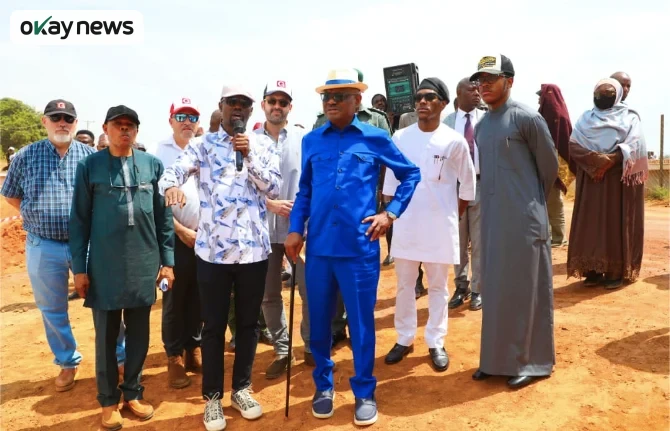
Wike gave the update on Thursday, February 12, 2026, during an inspection of ongoing road construction and related infrastructure projects across Abuja, the city that makes up the Federal Capital Territory (FCT).
The Federal Capital Territory Administration began building the terminals in 2024, with sites at Kugbo and Mabushi, both in Abuja, as well as a third terminal in the Central Business District, the city’s main commercial area. The Kugbo and Mabushi terminals were completed and inaugurated in June 2025 to mark President Bola Ahmed Tinubu’s second year in office, while the Central Business District terminal is near completion. Despite the earlier inauguration, the terminals have not started operating.
Wike said the delay is because the contract for qualified operators must receive approval from the Federal Executive Council (FEC), adding that the process is beyond what his office can finalise alone. He also said the procurement process has already passed through the Bureau of Public Procurement (BPP), Nigeria’s federal agency that oversees public procurement standards.
“After building the terminals, we said we are not going to allow the Transport Secretariat to run it. It will be handled by private individuals who have the competence.
“It’s not as easy as we thought. It requires FEC’s approval, but I am confident that at the next FEC, the contracts will be presented for approval. So, we believe in the next FEC meeting it will be approved, and once that is done, then. We will hit the road,” the minister explained.
Okay News reports that the planned move to private operators is part of efforts by the Federal Capital Territory Administration to improve public transport management and reduce disorder at major loading points in the city.
The minister also raised concerns about vandalism targeting public infrastructure in Abuja, saying additional security measures are being introduced to protect ongoing projects and completed installations.
“You remember that we contracted out the street lighting to the China Civil Engineering Construction Corporation and China Geo-engineering Corporation. One of the features is that they will include security measures so that they cannot be manipulated, removed, or vandalised.
“CCECC is doing well. They have almost finished one at the airport road with these security features, which you may not know,” he said.
He added, “Most of the jobs we have done are being vandalised by criminals. We will take steps to ensure that, by the time the two companies finish, this will no longer happen. That’s why we are concerned about security features.
“I mean, how many policemen would you have on the road to check for vandalism of street lights? By the time the projects are completed, we’ll be able to monitor the situation from a kind of control room. That is how we are trying to reduce vandalism.”
On road construction, Wike described the current works as key to improving movement across the Federal Capital Territory, especially links between major districts and commercial areas.
“Well, as you can see, it is a marathon inspection today. We went to Wuse, linking to the Central Business Area, which was developed by Levant Construction Company. By the grace of God, as they have said, the project will be handed over by June,” he said.
The minister said many of the ongoing initiatives, including road networks, bus terminals, and street lighting upgrades, are largely funded through the Federal Capital Territory’s internally generated revenue rather than Nigeria’s federation account, a central pool that distributes national revenue to federal, state, and local governments. He said the projects are aimed at improving daily life for residents and supporting economic activity across Abuja.