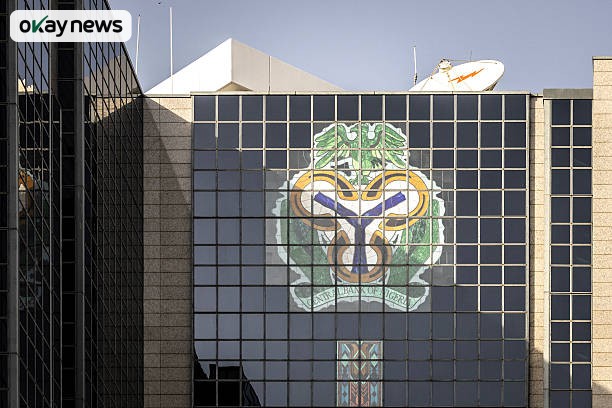
Lagos, Nigeria – The Central Bank of Nigeria (CBN) has confirmed that its Scripless Securities Settlement System (S4) is now fully operational as the exclusive platform for primary market auctions of government securities.
Okay News reports that this cements S4 as the sole gateway for bid submission, price discovery, and allocation in Nigeria’s sovereign debt market.
The confirmation followed the February 2026 Treasury Bills auction, in which the federal government offered ₦150 billion (approximately $97 million) in 91-day bills, ₦200 billion (approximately $129 million) in 182-day bills, and ₦800 billion (approximately $516 million) in 364-day bills, all processed through the centralised electronic system. Market observers describe the auction as a decisive structural reset for Nigeria’s primary debt market architecture.
By eliminating physical submissions and decentralised aggregation channels, the CBN has consolidated all primary market activity within a single electronic window, reshaping interactions among banks, investors, and regulators.
In its February 4 auction notice and operational guidelines, the CBN mandated the use of S4 as the single clearing channel for all primary market participation in Treasury Bills and other government securities. Only authorised banks can submit bids on behalf of investors, with all transactions converging directly within the S4 interface.
“S4 has become the only tool used by CBN for government securities auction in the primary market. It is fully working now,” said Mr. Auwalu of CBN’s Corporate Communications Department. “However, only banks can send customer bids. Investors must submit through their banks,” he added.
Industry experts, including Mr. Zeal Akariwe, CEO of Graeme Blaque Advisory, note that the move aims to enhance transparency rather than signal a major operational change. The apex bank is also exploring S4 deployment for secondary market trading.
The full deployment of S4 reflects technological enforcement and policy standardisation in Nigeria’s sovereign debt issuance. All bids are now transmitted electronically through authorised banks, with allocation, confirmation, and settlement occurring entirely within the CBN’s system. Decentralised aggregation channels previously used by intermediaries have been removed, centralising auction visibility and reducing informational asymmetry. Analysts describe the shift as one of the most significant changes to Nigeria’s fixed-income market in over a decade, with potential effects on transparency, pricing, and monetary policy transmission.
“The full deployment of S4 effectively redraws the governance map of Nigeria’s primary fixed-income market,” said Mr. Tajudeen Olayinka, CEO of Wyoming Capital and Partners Limited. “Price discovery is now centralised, informational asymmetry reduced, and auction mechanics digitised within a controlled regulatory environment.” The reform also changes the role of Primary Dealer Market Makers, shifting them from discretionary gatekeeping to execution and liquidity facilitation.
The S4 system now underpins a more transparent, centralised, and policy-sensitive primary market. Policymakers gain real-time visibility of sovereign funding and investor behaviour, while centralised auctions support monetary policy transmission through cleaner price discovery. Banks transition from intermediaries to execution facilitators, and investors operate in a transparent yet policy-influenced pricing environment. The deployment underscores the CBN’s strategy of strengthening control over liquidity channels while prioritising market stability over convenience.
Although the S4 interface has existed since 2014, it was not fully deployed until last year. Previously, Treasury Bill auctions relied on physical or proxy submissions through the CBN Issue Office or Primary Dealer Market Makers, who collated bids for investors and institutions. Following operational challenges in late 2025, the apex bank has centralised the entire auction workflow into a digital, dealer-neutral platform. This ensures digitised bid submission, allocation, and settlement, reduces pricing opacity, limits discretionary influence, and aligns with broader capital market infrastructure upgrades across Nigeria’s financial system.
With the CBN firmly at the centre of primary market execution, Okay News reports that S4’s evolution could reshape yield behaviour, allocation dynamics, and investor strategy across Nigeria’s fixed-income landscape.