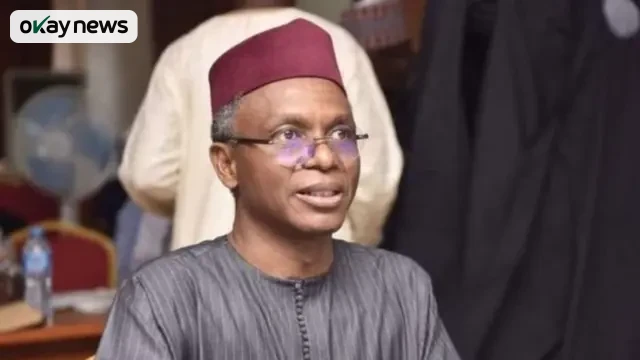
Abuja, Federal Capital Territory, Nigeria – Nigeria’s domestic intelligence agency, the Department of State Services, has scheduled Wednesday, February 25, 2026, for the arraignment of former Kaduna State Governor, Nasir El-Rufai, before the Federal High Court in Abuja, the capital of Nigeria.
The charges relate to alleged cybercrime offences and a breach of national security involving the reported interception of the telephone communications of Nigeria’s National Security Adviser, Nuhu Ribadu.
The case, marked FHC/ABJ/CR/99/2026, was assigned to Justice Joyce Abdulmalik by the Chief Judge of the Federal High Court, Justice John Tsoho. The court fixed Wednesday, February 25, 2026, for El-Rufai to take his plea.
Court documents show that the Department of State Services filed a three-count criminal charge on Monday, February 16, 2026. The agency accused the former governor of unlawfully intercepting the telephone lines of the National Security Adviser.
According to the prosecution, the alleged actions violate provisions of the Cybercrimes Prohibition, Prevention, etc. Amendment Act, 2024, and the Nigerian Communications Act, 2003. These laws regulate digital communications, cyber activities, and telecommunications operations in Nigeria.
In the first count, the Department of State Services alleged that on Thursday, February 13, 2026, while appearing as a guest on Arise Television’s Prime Time Programme in Abuja, El-Rufai admitted during the interview that he and others unlawfully intercepted the phone communications of the National Security Adviser. The agency said the alleged act is contrary to Section 12(1) of the Cybercrimes Prohibition, Prevention, etc. Amendment Act, 2024.
In the second count, the former governor was accused of stating during the same live television interview that he knew and related with an individual who unlawfully intercepted the National Security Adviser’s phone communications but failed to report the person to relevant security agencies. The Department of State Services said the alleged offence is punishable under Section 27(b) of the Cybercrimes Prohibition, Prevention, etc. Amendment Act, 2024.
During the Arise Television broadcast, El-Rufai claimed that he overheard the National Security Adviser directing security operatives to detain him. He linked the alleged directive to what he described as an attempted arrest at the Nnamdi Azikiwe International Airport in Abuja on Wednesday, February 12, 2026, after he returned from Cairo, Egypt.
The development is significant because it places a former state governor at the centre of a high profile national security case involving Nigeria’s top security adviser. It also raises questions about the scope of cybercrime enforcement and the limits of political commentary in a highly charged political climate.
Okay News reports that the arraignment will formally begin criminal proceedings, where the charges will be read and the defendant will enter a plea. Legal analysts say the case could test the interpretation of recent amendments to Nigeria’s cybercrime legislation.
El-Rufai had earlier been granted administrative bail at about 8 p.m. West African Time, which is GMT+1, on Wednesday, February 18, 2026, after being detained by Nigeria’s main anti corruption agency, the Economic and Financial Crimes Commission, over questioning in an alleged ₦432 billion fraud case. At an estimated exchange rate of ₦1,500 to $1, the amount is about $288 million.
Shortly after his release, he was reportedly taken into custody by another anti corruption body, the Independent Corrupt Practices and Other Related Offences Commission.
The arraignment on Wednesday, February 25, 2026, is expected to determine the next legal steps, including possible bail conditions and trial dates.