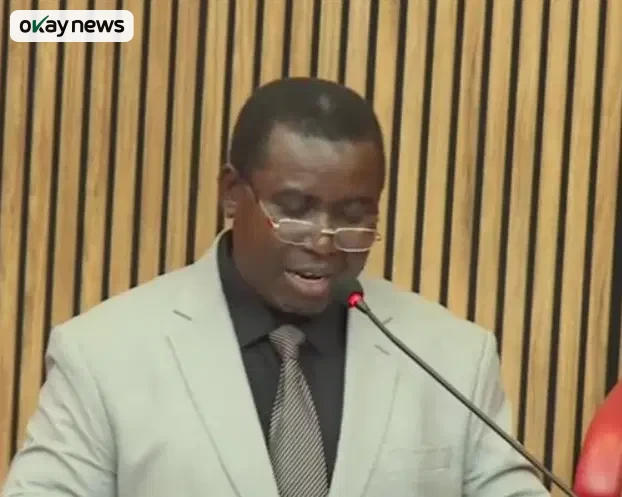
Abuja, Nigeria — The Independent National Electoral Commission of Nigeria, the country’s constitutionally mandated body responsible for organising federal and state elections, has raised concerns that persistent internal crises within political parties are distracting it from preparations for the 2027 general elections.
The Chairman of the Independent National Electoral Commission, Professor Joash Amupitan, a Senior Advocate of Nigeria, made this known at the opening of a three day Technical Review Workshop in Ikot Ekpene, a town in Akwa Ibom State in southern Nigeria. The workshop marked the start of a comprehensive review of the Commission’s Regulations and Guidelines for Political Parties to align them with the Electoral Act 2026, Nigeria’s updated electoral law.
According to a bulletin issued by the Commission in Abuja, Nigeria’s capital city, the workshop is supported by the Westminster Foundation for Democracy, a United Kingdom based organisation that promotes democratic governance. The review is intended to strengthen Nigeria’s electoral framework as preparations intensify for the next nationwide vote scheduled for 2027.
Professor Amupitan warned that recurring leadership struggles and prolonged intra party disputes are taking a toll on the Commission’s core responsibilities.
“The quality of internal party democracy has a direct bearing on the election conducted by INEC. Each day spent defending avoidable intra-party disputes is a day diverted from our primary mandate of election planning.
“While the Commission remains neutral, it will enforce compliance firmly and consistently.”
He explained that the revised regulations would introduce tighter standards on financial transparency, documentation of party membership, and the inclusion of women, young people and Persons with Disabilities in party structures and processes.
“We are not just editing a document. We are aligning our Regulations and Guidelines with the 2026 Act to ensure that our electoral architecture is not only robust in theory but strong in practice.
“The sovereign will of the Nigerian people must remain sacrosanct from the point of candidate nomination to the final declaration of results.”
Under the newly adjusted timetable released by the Commission, presidential and National Assembly elections will take place on Saturday, January 16, 2027, while governorship and state assembly elections are scheduled for Saturday, February 6, 2027. Political party primaries, during which parties select their candidates, are expected to hold between Thursday, April 23 and Saturday, May 30, 2026.
Dr. Baba Bila, a National Commissioner at the Independent National Electoral Commission and Chairman of its Election and Party Monitoring Committee, described the review as strategically important. He said the existing guidelines require substantial amendments to reflect the provisions of the Electoral Act 2026.
The Country Director of Westminster Foundation for Democracy Nigeria, Mr. Adebowale Olorunmola, urged political parties to develop more inclusive and internally democratic systems to protect the integrity of the 2027 elections.
However, the Commission’s comments have drawn criticism from political leaders and parties who argue that voter apathy in Nigeria is rooted more in public distrust of the electoral process than in party infighting.
The National Working Committee of the New Nigeria Peoples Party, one of Nigeria’s registered political parties, said internal disputes may create administrative difficulties but are not the primary reason many citizens are disengaged from elections.
The National Publicity Secretary of the New Nigeria Peoples Party, Bamofin Ladipo Johnson, said while the Commission is frequently joined as a party in pre election court cases and may therefore face litigation burdens, it must confront what he described as a credibility crisis.
“It is understandable that INEC complains about the disturbances caused by internal party disputes,” Johnson said. “Because the Commission is often joined as a necessary party in these suits, it inevitably drains their time and resources.”
He added: “The greatest cause of voter apathy in Nigeria is not internal party friction; it is the widespread perception that INEC is complicit in subverting the will of the people.
“A large percentage of the voting public remains convinced that the system is rigged and that their ballots do not count. This crisis of confidence is the primary driver of voter apathy. Until INEC demonstrates absolute transparency and proves it is an unbiased arbiter, no amount of internal party stability will bring Nigerians back to the polling units.”
Senator Victor Umeh, who represents Anambra Central Senatorial District in southeastern Nigeria, said the Commission could only restore public interest in elections by conducting credible polls.
“The Commission can only resurrect citizens’ interest in elections if it conducts credible elections,” he said.
“The citizens have lost interest in elections due to lack of transparency. The Commission has to do a lot to convince the electorate to come out during elections to cast their votes.”
Senator Neda Imasuen, who represents Edo South Senatorial District and serves as Chairman of the Senate Committee on Ethics, Code of Conduct and Public Petitions in Nigeria’s upper legislative chamber, partly agreed with the Commission. He said persistent party disputes and conflicting court judgments often leave the electoral body in difficult positions.
“I agree with the INEC chairman because party infighting and squabbles can be a distraction,” he said.
“Most of these party internal crises end up in courts, giving conflicting judgments and leaving INEC in limbo. Constant party crises can also create voter apathy as political affiliations are shattered, leaving voters to stay away from voting altogether.”
A former National Chairman of the Inter Party Advisory Council, a body that brings together registered political parties in Nigeria, Chief Peter Ameh, urged the Commission to focus on rebuilding trust rather than shifting responsibility.
Speaking in Abuja, he said concerns arising from the handling of the 2023 presidential election had not been fully addressed.
“There is a trust deficit between the votes cast and counted at the various units and what INEC eventually declared,” he said.
“The infamous ‘technical glitch’ which INEC claimed while collating and announcing the results of that election eroded over 70 per cent of public trust.
“People are now led to believe that their votes don’t count; what counts are those who count and announce the results, which by law is INEC.”
Ameh added that many Nigerians believe the Commission is too close to the ruling party and argued that only transparent and verifiable elections would rebuild confidence.
“Citizens must be convinced that their votes will count in order to believe in the system enough to come out and vote on Election Day,” he said.
He also noted that the current chairman is newly appointed and faces a significant responsibility.
“One can only wish the new INEC chairman well because he just took office and is learning on the job, but he must remember the task before him is one on which the lives of over 200 million Nigerians depend.”
Okay News reports that with party primaries only months away and new regulatory guidelines under review, tensions are already surfacing ahead of the 2027 general elections. While the Commission maintains that weak internal party democracy and prolonged litigation are stretching its resources, critics insist that restoring public confidence through credible and transparent elections will be decisive in reversing voter apathy.