


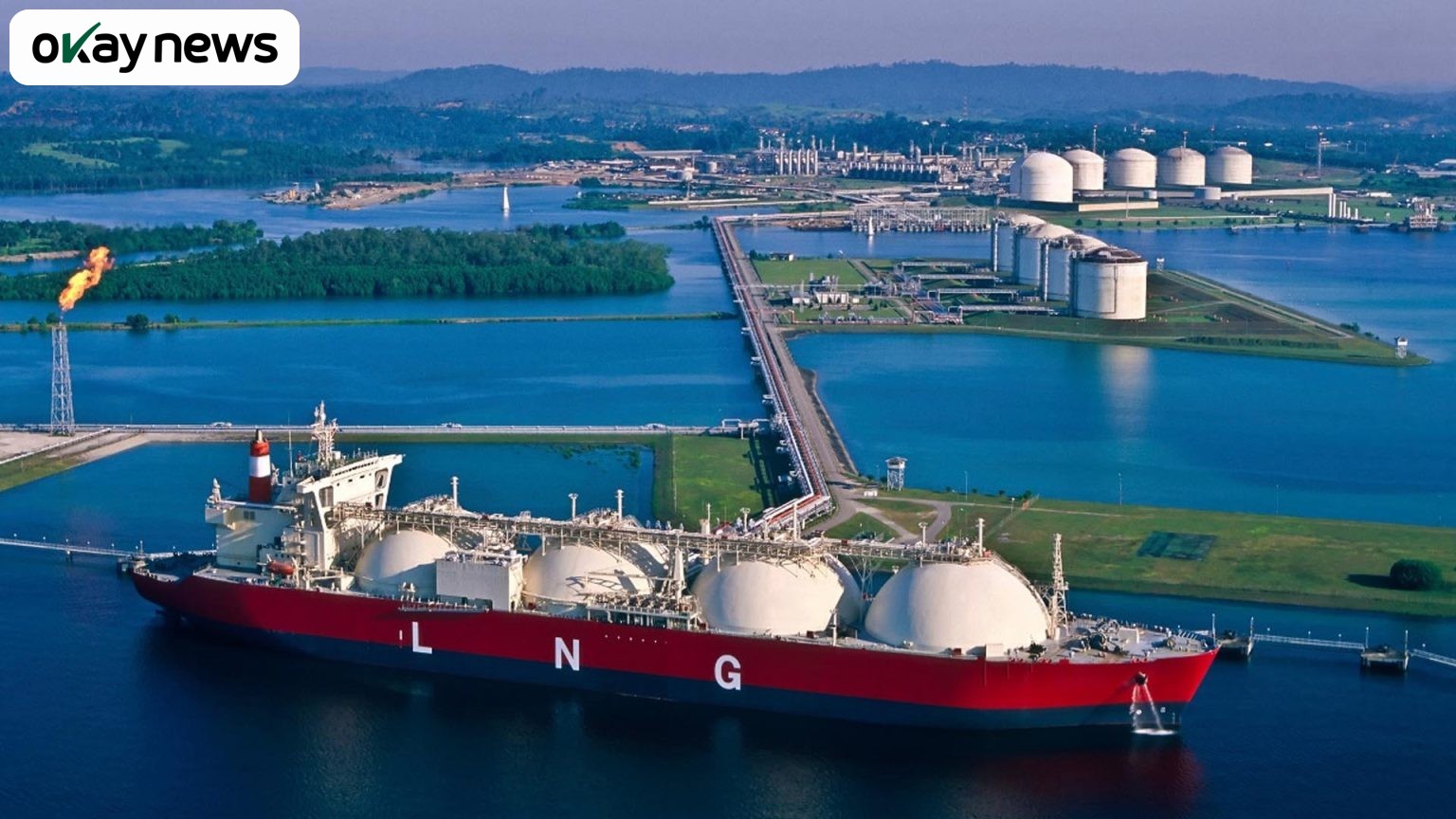
Nigeria’s liquefied natural gas (LNG) exports are set to benefit significantly in 2026 as global supply rises sharply, easing constraints that have persisted since the 2022 Ukraine war. Analysts say the surge will lower prices and stimulate demand from major importers such as China and India.
Okay News reports that global LNG output is forecast to increase by up to 10% year-on-year, with new capacity from the United States, Qatar, Canada, and West Africa expected to reshape the market. Industry observers describe 2026 as a “transitional year,” moving from tight supply toward ample availability, particularly in Europe.
Nigeria’s LNG exports rebounded strongly in late 2025, hitting a five-year high in December with 2.1 billion cubic meters shipped. Improved gas supply, higher plant utilisation, and infrastructure progress, including the OB3 pipeline, positioned the country for further growth.
The $4.3 billion NLNG Train 7 project is central to Nigeria’s expansion plans, expected to lift capacity from about 22 to 30 million tonnes per annum (MTPA). This development strengthens Nigeria’s role as Africa’s largest gas exporter, ahead of rivals like Algeria.
Global supply forecasts from S&P Global Energy, Kpler, and Rystad Energy project between 460 million and 484 million metric tons of LNG in 2026. Projects such as Golden Pass LNG in the U.S. and Qatar’s North Field expansion will add substantial volumes, while new facilities in Senegal and Mauritania will contribute to Africa’s share.
The additional supply is expected to pressure prices. Analysts predict Asian spot LNG will average $9.50–$9.90 per mmBtu in 2026, down from $12.45 in 2025. European benchmark prices at the Title Transfer Facility are forecast to fall to around $9.50–$9.74 per mmBtu, compared to $14.20 last year.
Nigeria’s share of global LNG supply has fluctuated, holding about 6% in 2022 and 5–8% in early 2025. With proven reserves of over 210 trillion cubic feet (Tcf), the largest in Africa, Nigeria remains a strategic supplier to Europe and Asia despite infrastructure challenges.
China and India are expected to drive demand growth, with imports rising by 6–7 million tons and 5 million tons respectively. Europe, meanwhile, is projected to absorb an additional 13–22 million tons as it phases out Russian gas and increases storage injections.
The combination of rising global supply, easing prices, and Nigeria’s infrastructure expansion positions the country to capture new market opportunities. Analysts say the next four years will be critical in determining Nigeria’s long-term role in the global LNG trade.


 exports are set to benefit significantly in 2026 as global supply rises sharply, easing constraints that have persisted since the 2022 Ukraine war. Analysts say the surge will lower prices and stimulate demand from major importers such as China and India.)