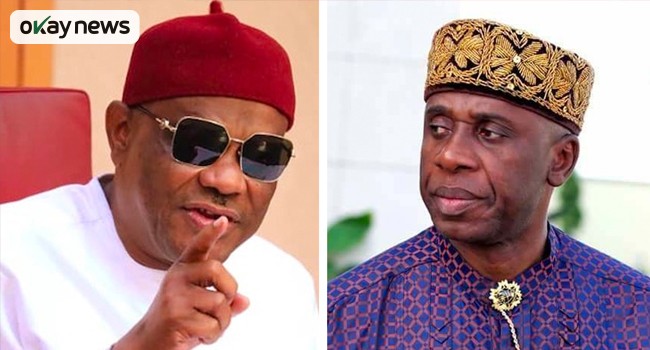
ABUJA, Nigeria — The Minister of the Federal Capital Territory of Nigeria, Nyesom Wike, has accused former Minister of Transportation, Rotimi Amaechi, and other opposition figures of double standards over the controversy surrounding electronic transmission of election results in Nigeria’s newly amended Electoral Act 2026.
Wike made the remarks during a media chat in Abuja, the capital of Nigeria, on Monday, March 2, 2026, while responding to criticisms from opposition parties about the Electoral Act 2026 recently signed into law by Nigeria’s President, Bola Tinubu.
The Electoral Act is the primary law governing how elections are conducted in Nigeria, Africa’s most populous country and one of its largest democracies. A key area of debate in the new legislation concerns the transmission of election results. Opposition groups have objected to a clause that allows for manual transmission of results if electronic transmission fails due to poor network coverage.
Critics argue that permitting manual transmission in certain circumstances could weaken transparency in a country where electoral credibility has often been questioned. However, Wike rejected that interpretation, saying the provision is a safeguard to ensure that voters are not disenfranchised when technology fails.
Okay News reports that Wike also used the opportunity to criticise Amaechi’s past position on electronic transmission when both men served in government under former President Muhammadu Buhari.
“Remember, under Buhari, the issue of electronic transmission came. People like Rotimi Amaechi, they were in government, they said, ‘no, don’t sign, if you sign, you lose the election’.
“And this is the same person now who is coming out in public to say there should be electronic transmission, but he refused simply because he felt his boss would be affected,” Wike said.
Wike maintained that the new law does not eliminate electronic transmission of results. Instead, he said, it introduces flexibility in situations where electronic systems may not function properly, particularly in rural or remote communities with limited telecommunications infrastructure.
“Now we are here, they did not say there should not be an electronic transmission. All they said is in case, and which is likely, let us not disenfranchise people by not allowing their votes to be counted,” he said.
Beyond the issue of result transmission, Wike addressed another controversial provision in the Electoral Act 2026 that requires political parties to adopt direct primaries when selecting candidates for elections. Under Nigeria’s political system, direct primaries allow all registered party members to vote in choosing candidates, while indirect primaries rely on selected delegates.
According to Wike, the indirect primary system has historically enabled powerful office holders, including state governors and federal ministers, to dominate party structures and influence candidate selection through financial and political leverage. He argued that mandating direct primaries would reduce the influence of wealthy political actors and strengthen internal party democracy.
The minister also criticised what he described as a pattern of persistent complaints among segments of the political class. He noted that some individuals who previously condemned indirect primaries for empowering elite interests are now resisting reforms designed to address those concerns.
The controversy comes amid mounting pressure from opposition parties, including the African Democratic Congress and the New Nigerian Peoples Party. About a week earlier, the parties urged Nigeria’s National Assembly, the country’s federal legislature, to begin a fresh amendment process to remove what they described as “obnoxious provisions” in the Electoral Act 2026.
They argued that certain clauses in the amended law are “anti-democratic” and could undermine transparency and weaken public confidence in Nigeria’s electoral process.
The debate over the Electoral Act is significant because Nigeria is preparing for future general elections in a political environment where trust in electoral institutions remains fragile. The way results are transmitted and candidates are selected within parties could shape public perception of fairness and legitimacy in the country’s democratic system.
As discussions continue between the executive branch, lawmakers, and opposition parties, attention is now turning to whether the National Assembly will revisit the law or allow its current provisions to stand ahead of upcoming electoral cycles.