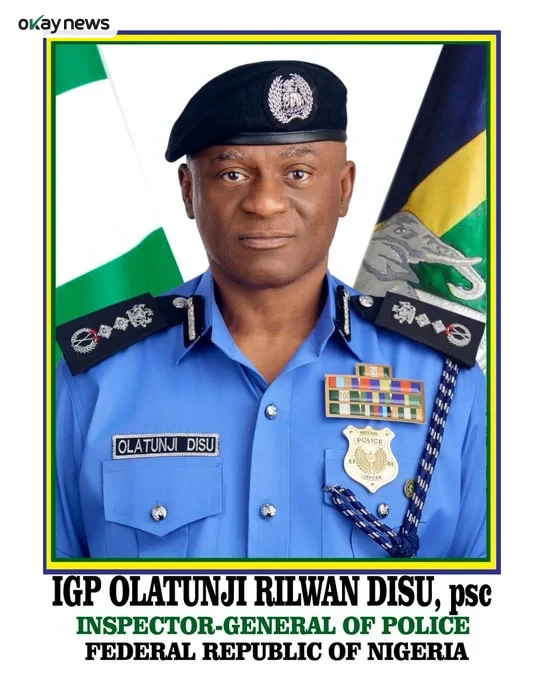
Abuja, Nigeria — The Inspector General of the Nigeria Police Force, Tunji Disu, on Wednesday inaugurated an eight member committee to coordinate the implementation of state policing across Nigeria, marking a significant step in the federal government of Nigeria’s broader security reform agenda.
Disu, who was recently confirmed as the 23rd indigenous Inspector General of Police, announced the formation of the committee during his first formal meeting with senior officers since his confirmation. His appointment was unanimously endorsed by the Nigeria Police Council, a constitutional body responsible for overseeing policing matters in the country, following his nomination by President Bola Ahmed Tinubu of Nigeria.
Okay News reports that the committee will oversee the framework for establishing state police structures and support the rollout of the Inspector General’s policing vision nationwide. Professor Olu Ogunsakin has been appointed to chair the eight member committee.
Addressing senior officers at the meeting in Abuja, Nigeria’s capital city, Disu emphasised that leadership within the police force must go beyond rank or office. He told the gathering that leadership is “not about position but responsibility,” stressing that professionalism, accountability, and discipline must define policing operations across all commands in Nigeria’s 36 states and the Federal Capital Territory.
He further stated that authority within the force must be exercised carefully and responsibly. According to him, respect for human rights must remain central to policing activities, adding that every Nigerian citizen must be treated with dignity, fairness, and justice, regardless of social or economic background.
In addition to the state policing initiative, the Inspector General announced plans to strengthen internal accountability mechanisms within the Nigeria Police Force. He directed that the Public Complaint Unit, which handles complaints against police officers, and the X Squad, an internal disciplinary unit tasked with investigating misconduct, be empowered to function independently in order to improve transparency and public trust.
The move toward state policing represents a significant shift in Nigeria’s security structure. Currently, policing in Nigeria is centrally controlled by the federal government, with operational commands deployed across the country. Advocates of decentralisation argue that state policing will allow individual state governments to play a more direct role in managing security challenges within their territories, thereby improving response times and local intelligence gathering.
The inauguration of the committee comes at a critical time for the Nigeria Police Force following recent leadership changes. On Monday, February 24, 2026, President Bola Ahmed Tinubu appointed Disu as Acting Inspector General of Police after the resignation of his predecessor, Kayode Egbetokun. The appointment followed a meeting between the outgoing police chief and the President at the Presidential Villa in Abuja.
Disu’s appointment was later ratified unanimously by the Nigeria Police Council, clearing the way for his formal swearing in as substantive Inspector General of Police during a meeting of the Federal Executive Council, Nigeria’s highest executive decision making body.
Nigeria, Africa’s most populous country with more than 200 million people, has in recent years faced escalating security concerns, including kidnappings for ransom, armed banditry in rural regions, and violent attacks on communities. The state police initiative is part of a broader reform programme introduced by the current administration to decentralise security powers and strengthen law enforcement responsiveness at local levels.
With the implementation committee now inaugurated, attention will shift to how quickly legislative and administrative steps can be completed to operationalise the new structure and address concerns about funding, oversight, and coordination between federal and state authorities.