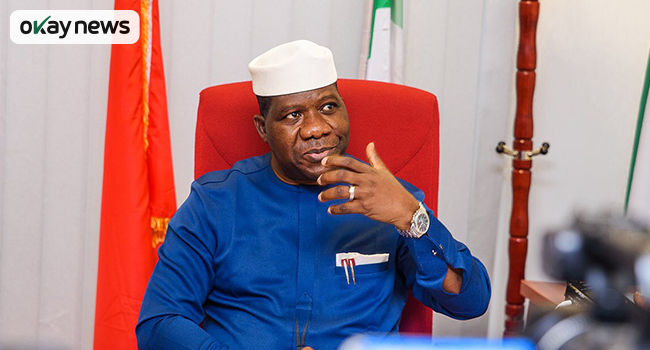
Nigeria’s Senate Leader, Senator Opeyemi Bamidele, a senior lawmaker representing Ekiti Central Senatorial District in the National Assembly of the Federal Republic of Nigeria, has dismissed claims that the country’s newly enacted tax laws were designed to impose hardship on citizens.
Bamidele stated that the tax reforms are deliberately structured as people-focused interventions meant to strengthen Nigeria’s fiscal framework while improving the quality of life for ordinary Nigerians, particularly those in lower income brackets.
The Senate Leader made the clarification in a statement released on Wednesday in Abuja, Nigeria’s federal capital city, amid rising public debates and criticism from opposition political actors regarding the implementation of the new tax regime. He said the intention behind the legislation has been widely misunderstood and misrepresented.
“The new tax law was not initiated to inflict economic hardship on ordinary people, as being misconstrued in the public space,” he said.
According to him, the Nigerian Senate and the National Assembly as a whole worked closely with other arms of government in shaping the reforms, while maintaining the constitutional independence assigned to the legislature.
“The Senate, indeed the National Assembly, has collaborated with other arms of government to effect the reforms without any prejudice to our constitutionally guaranteed independence,” he said.
Bamidele highlighted several milestones achieved by the legislature during the 2025 financial year, including the enactment of a new tax regime, the discontinuation of multiple budget practices, ongoing constitutional review efforts, and reforms aimed at improving Nigeria’s electoral credibility.
“In the 2025 financial year, we have achieved quite a lot in enacting a new tax regime; ending the culture of multiple budgets; working with key stakeholders to review the 1999 Constitution and recalibrating our electoral regime to be more credible and transparent,” he explained.
Okay News reports that Bamidele described the 2025 Tax Reforms Act as the most significant of all recent reforms, noting that its primary objective is to harmonise Nigeria’s tax system and eliminate multiple taxation beginning from Thursday, January 1, 2026.
“The enactment of the 2025 Tax Reforms Act, for instance, is perhaps the most consequential of all these reforms. Its core intention is to introduce a cohesive tax regime that will, from January 1, 2026, end the era of multiple taxation and ensure improved life for the citizenry, especially for those at the lowest rung of our national economy,” he added.
He stressed that the law followed extensive consultations involving stakeholders from the business community, political institutions, and social groups across the country, countering claims that the process was rushed or exclusive.
“The Act, duly enacted after multi-levelled consultation with stakeholders across business, political and social interests, does not represent the gloomy picture the opposition forces are painting,” Bamidele said.
The Senate Leader urged Nigerians to carefully study the provisions of the Tax Reforms Act and avoid misinformation as aspects of the new obligations gradually take effect. He reaffirmed the legislature’s commitment to national development and support for the policy direction of President Bola Tinubu’s administration.
President Bola Tinubu, Nigeria’s current Head of State and Government, has also reaffirmed that the implementation of the tax laws enacted on Wednesday, June 26, 2025, and others scheduled for Thursday, January 1, 2026, will proceed as planned. He described the reforms as a historic opportunity to create a fair and modern fiscal structure.
Tinubu said the reforms are not intended to increase taxes arbitrarily but to promote harmonisation, protect human dignity, and strengthen the social contract between the Nigerian government and its citizens.