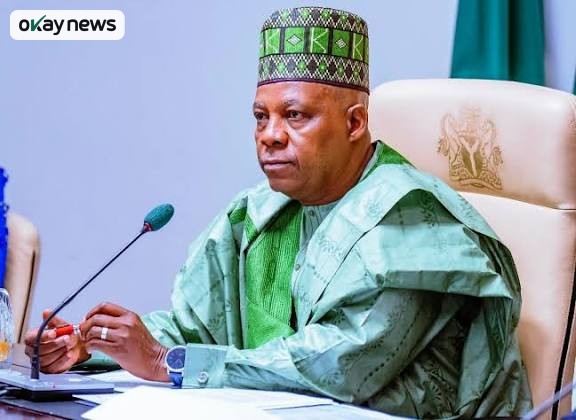
Nigeria’s Vice President, Kashim Shettima, has arrived back in Abuja, Nigeria’s capital, after a week-long diplomatic and economic trip to Guinea-Conakry and Switzerland, saying the visits showed Nigeria has returned to a prominent place in regional and global policy discussions.
Shettima landed at Nnamdi Azikiwe International Airport, Abuja’s main international airport, on Saturday, 24 January 2026, after representing Nigeria’s President, Bola Ahmed Tinubu, at the inauguration of Guinea’s leader, President Mamadi Doumbouya, and leading Nigeria’s delegation to the 56th World Economic Forum (WEF) Annual Meeting in Davos, a Swiss resort town that hosts an annual gathering of global political and business leaders.
In his comments on the trip, the Vice President linked the engagements to the Tinubu administration’s plan to revive the economy, widely described by the government as the “Renewed Hope” agenda. Okay News reports that Shettima said the mission reflected Nigeria’s renewed push for regional cooperation and a stronger international presence.
Stanley Nkwocha, the Senior Special Assistant to the President on Media and Communications in the Office of the Vice President, shared details of the trip in a post on X, the social media platform formerly known as Twitter.
According to the Vice President, Nigeria used the Guinea-Conakry visit to reinforce its role within the Economic Community of West African States (ECOWAS), the regional bloc that promotes economic integration and political cooperation across West Africa. He said discussions also explored new areas for cooperation between Nigeria and Guinea, especially in agriculture and manufacturing.
In Davos, Shettima led Nigeria’s participation at the World Economic Forum and also oversaw the opening of “Nigeria House Davos”, described as the country’s first sovereign pavilion on the Davos Promenade. The pavilion is intended to serve as a standing investment showcase, highlighting opportunities in areas such as solid minerals, agriculture, and the digital economy.
The Vice President also spoke at a session titled “When Food Becomes Security”, where he presented Nigeria’s updated national food security framework. He described agriculture as central to national stability, linking food production to broader issues such as security and macroeconomic performance.
Beyond the forum meetings, Shettima took part in the Accra Reset Initiative, a policy-focused effort aimed at boosting African industrial development through stronger domestic investment and value chains. The session included Nigeria’s former President, Olusegun Obasanjo, former Vice President, Yemi Osinbajo, and Nigeria’s Minister of Finance, Wale Edun.
On Nigeria’s economic outlook, the Vice President told investors that key indicators were improving. He pointed to projected gross domestic product (GDP) growth of 4.4 per cent in 2026 and a forecast decline in inflation to 12.94 per cent. He also said Nigeria expects to increase the local supply of refined fuel through the Dangote Refinery, a major private oil refinery project near Lagos, Nigeria’s commercial hub, and that the country is also expanding exports of technology skills through its growing pool of digital talent.
Overall, officials framed the trip as part of Nigeria’s twin strategy of strengthening regional diplomacy in West Africa while seeking more global investment and partnerships, as the government works to raise growth and improve economic confidence.