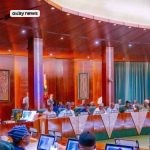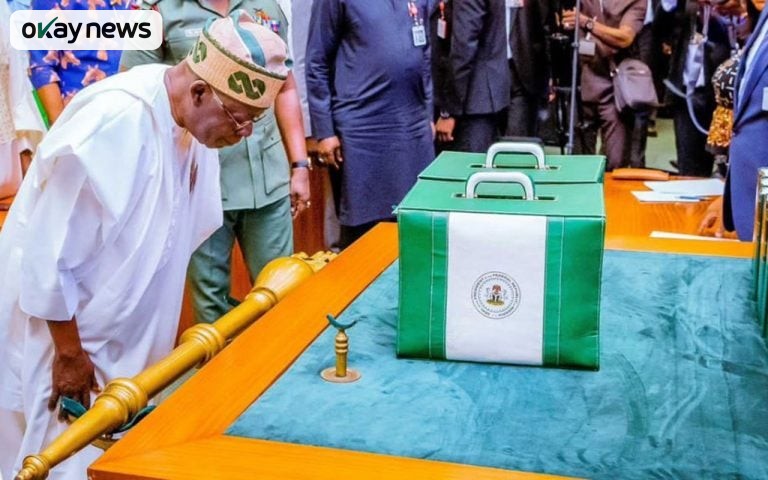
Nigeria’s President, Bola Ahmed Tinubu, on Friday, 19 December 2025, presented the proposed ₦58.18 trillion 2026 Appropriation Bill to a joint session of Nigeria’s National Assembly in Abuja, Nigeria’s federal capital, announcing that ₦5.41 trillion has been earmarked for defence and internal security, the highest single allocation in the budget.
The allocation confirms security as the dominant spending priority of the administration for the third consecutive year, continuing a trend that began with the 2024 and 2025 national budgets amid ongoing security challenges across different regions of Africa’s most populous country.
Okay News reports that President Tinubu told lawmakers that national security remains the backbone of economic growth, investment confidence, and social stability, stressing that no meaningful development can take root in an atmosphere of fear and violence.
“Security remains the foundation of development,” the President said, explaining that economic reforms, infrastructure expansion, and social investments depend on peace and stability across Nigeria’s thirty-six states.
Under the proposal, defence and security spending will surpass allocations to other critical sectors, including infrastructure, education, and health. The President noted that the sustained prioritisation reflects the government’s determination to confront persistent threats such as terrorism, banditry, kidnapping, and violent criminal networks.
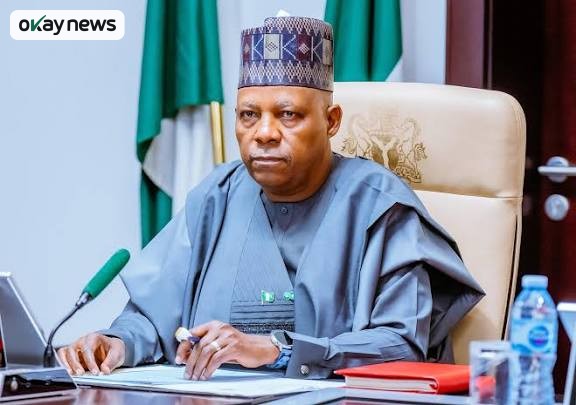
Earlier on Friday, Nigeria’s Federal Executive Council, the country’s highest policy-making body chaired by the President and comprising cabinet ministers, approved the 2026 budget framework at an emergency meeting presided over for the first time by Nigeria’s Vice President, Kashim Shettima. The council approved a total expenditure ceiling of ₦58.47 trillion, citing intense fiscal pressures from debt servicing obligations, public sector wages, and security operations.
Breaking down the security component, President Tinubu said the ₦5.41 trillion allocation would be used to modernise Nigeria’s armed forces, expand intelligence-led policing, improve border surveillance, and strengthen joint operations among security agencies.
“We will invest in security with clear accountability for outcomes because security spending must deliver security results,” he told lawmakers.
The President also announced a major restructuring of Nigeria’s national security architecture, revealing plans for a new national counter-terrorism doctrine based on unified command structures, coordinated intelligence sharing, and community-based stability measures.
As part of the new approach, Tinubu declared that all armed groups operating outside the authority of the Nigerian state, including bandits, militias, kidnappers, armed gangs, and violent cult groups, would now be officially designated as terrorists. He added that financiers, informants, and political or community collaborators would face the same classification.
According to the President, the decision is intended to eliminate legal loopholes and operational weaknesses that have allowed violent groups to flourish for years.
Beyond security, the 2026 budget proposal allocates ₦3.56 trillion to infrastructure development, ₦3.52 trillion to education, and ₦2.48 trillion to healthcare services. Tinubu acknowledged the strain on public finances but maintained that the spending choices were unavoidable.
“Without security, investment will not thrive. Without educated and healthy citizens, productivity will not rise. Without infrastructure, jobs and enterprise will not scale,” he said.
The President urged members of the National Assembly to support the budget, describing it as a strategic effort to consolidate recent economic gains while restoring public trust in the government’s capacity to protect lives and property.