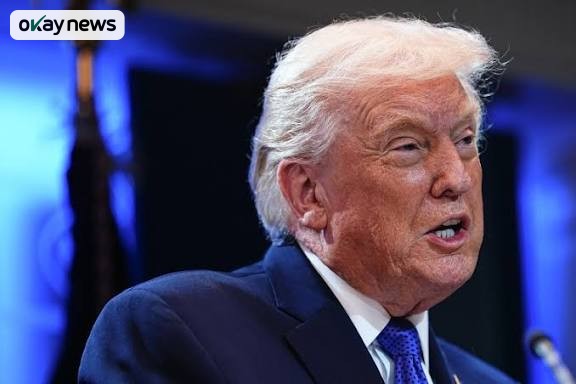
Washington, District of Columbia, United States — United States President Donald Trump announced an increase in the country’s global import tariff rate to 15 per cent, escalating his administration’s trade policy just one day after the Supreme Court of the United States ruled that much of his tariff framework was unlawful.
The decision followed a 6–3 ruling by the Supreme Court on Friday, February 20, 2026, which rejected the president’s authority to impose sweeping tariffs under a 1977 economic emergency powers law. The ruling represented a rare judicial rebuke for Mr Trump since he returned to office 13 months ago.
In a post on his social media platform, Truth Social, President Trump criticised what he described as an “extraordinarily anti-American decision” and said that after reviewing the court’s judgment, his administration would increase import duties “to the fully allowed, and legally tested, 15% level.”
Okay News reports that the new tariff level replaces an earlier 10 per cent global levy the president had introduced shortly after the court ruling by relying on a different legal basis.
The latest tariff order applies broadly to goods entering the United States from trading partners around the world. However, the measure is temporary under United States law and can remain in effect for up to 150 days. According to a White House fact sheet, exemptions will continue for certain sectors already under separate investigations, including pharmaceutical products, as well as goods traded under the United States–Mexico–Canada Agreement, a regional trade pact linking the three North American countries.
On Friday, the White House also indicated that countries which had negotiated separate tariff arrangements with the Trump administration would still be subject to the new 15 per cent global rate.
The Supreme Court’s ruling did not affect sector-specific tariffs previously imposed on steel, aluminium and other goods. Additional duties could still emerge from ongoing government investigations into particular industries.
President Trump publicly praised the three conservative justices who supported his position — Clarence Thomas, Samuel Alito and Brett Kavanaugh — thanking them “for their strength and wisdom, and love of our country.” At the same time, he criticised members of the majority, including two justices he nominated during his first term, alleging they had been “swayed by foreign interests.”
“I think that foreign interests are represented by people that I believe have undue influence,” he said.
The ruling marked the most significant legal setback for Mr Trump at the Supreme Court since his return to the White House. The court has generally expanded executive authority in other cases during his current term.
Financial markets reacted calmly. Shares on Wall Street rose modestly on Friday, reflecting expectations that the court might limit the administration’s approach. Business groups welcomed the decision. The National Retail Federation, a major United States trade association representing retailers, said the judgment “provides much-needed certainty” for companies.
During earlier court proceedings, lawyers for the Trump administration argued that companies would be eligible for refunds if the tariffs were ultimately deemed unlawful. The Supreme Court’s ruling did not address how such refunds would be handled. Justice Brett Kavanaugh noted that the refund process could become a “mess.”
International reaction has been cautious. Several governments said they were reviewing both the court decision and the new tariff announcement. German Chancellor Friedrich Merz, the head of government of Germany, Europe’s largest economy, said on Saturday that he would consult with European partners to develop “a very clear European position” and a joint response before travelling to Washington in early March.
Within the United States, Pennsylvania Governor Josh Shapiro, a member of the Democratic Party, urged the president to reconsider his trade approach. Writing on the social media platform X, he said it was time for Mr Trump to “listen to the Supreme Court, end chaotic tariffs, and stop wreaking havoc on our farmers, small business owners, and families.”
The latest move adds fresh uncertainty to global trade flows and supply chains, as businesses and governments attempt to assess the legal durability of the administration’s policies. Over the past year, multiple tariff rates have been introduced, revised or withdrawn, creating an unpredictable environment for exporters and importers.
The coming months are likely to bring further legal challenges and diplomatic negotiations as both domestic courts and foreign governments respond to Washington’s evolving trade strategy.