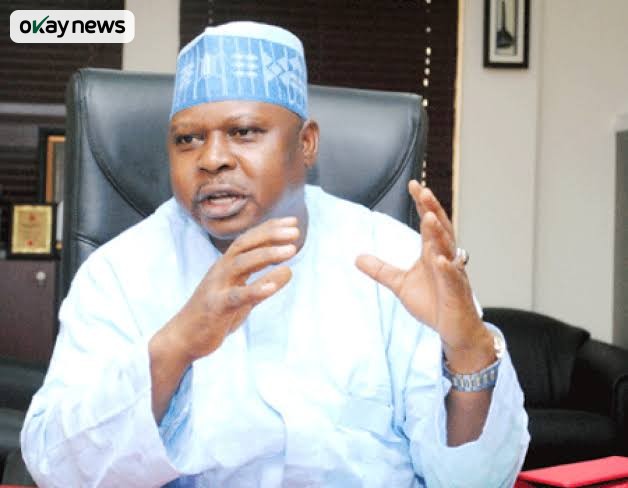
The National Chairman of the Peoples Democratic Party (PDP), Nigeria’s main opposition party, Tanimu Turaki, has rejected a recent ruling of the Federal High Court in Ibadan, a major city in south-western Nigeria’s Oyo State, describing it as an “academic exercise” while his team pursues an appeal.
Speaking at a press conference in Abuja, Nigeria’s capital, on Friday, 30 January 2026, Turaki, a Senior Advocate of Nigeria (SAN), said the party’s National Working Committee (NWC) has already filed a Notice of Appeal and a Motion for Stay of Execution to halt the effect of the judgment while the legal battle continues. Okay News reports that he also urged the Court of Appeal, Nigeria’s intermediate appellate court, to consolidate the various cases involving the party so that a single judgment can apply to all sides.
The dispute follows a decision by the Federal High Court in Ibadan which voided the PDP National Convention held in Ibadan on Saturday, 15 November 2025.
The court also directed Turaki and others to stop presenting themselves as national officers of the party, a move that deepens the internal crisis over who controls the party’s national secretariat and who can communicate officially with Nigeria’s election management body.
Before the ruling, PDP governors had backed the Ibadan convention that produced Turaki and other NWC members for a four-year tenure.
However, a rival bloc linked to the Minister of the Federal Capital Territory (FCT), Nyesom Wike, a senior member of Nigeria’s federal government and former Rivers State governor, insisted that its own leaders were still in charge as acting national officers, including those claiming the positions of Acting National Chairman and Acting National Secretary.
Turaki’s camp said the situation became more complicated after a transition was supervised from former chairman Umar Damagum to Turaki, even before Damagum’s tenure was due to expire on Tuesday, 9 December 2025.
On Monday, 8 December 2025, the rival bloc announced a 13-member caretaker committee with a 60-day mandate, naming Mohammed, Anyanwu and others as members, according to Turaki’s account of the party crisis.
As both camps pushed for recognition by the Independent National Electoral Commission (INEC), the government agency that regulates parties and conducts elections in Nigeria, the disagreement spilled into multiple court cases ahead of the 2027 general elections.
After the Ibadan judgment, the Turaki-led NWC, through its Publicity Secretary, Ememobong, said party lawyers had been instructed to file an immediate appeal and explore all available legal options.
The Wike-backed faction, on its part, welcomed the judgment restraining Turaki and others from acting as the party’s NWC.
Explaining his own position, Turaki said his camp initially went to court to seek an order of mandamus, a type of court order that compels a public institution to perform a duty, asking the court to direct INEC to recognise the Ibadan convention and allow official party communication with the commission.
He said the Mohammed and Anyanwu caretaker committee later applied to join the case, was admitted by the court, and filed processes opposing the reliefs sought.
Turaki argued that the court went beyond what the parties asked for, saying, “However, and most respectfully, the court proceeded suo motu to grant reliefs that were neither prayed for nor canvassed by any of the parties.”
He also maintained that the ruling clashes with earlier decisions from courts of the same level, saying it is “in material conflict with subsisting orders and previous judgments of courts of coordinate jurisdiction.”
“Consequently, we have filed a Notice of Appeal as well as a Motion for Stay of Execution of the judgement, and we are determined to pursue this matter diligently and to its logical conclusion in accordance with the law,” he said.
Turaki told party members that the ruling should not be seen as final, insisting that several similar cases are already before the Court of Appeal, and that a definitive decision will come from the appellate courts.
“For the avoidance of doubt, this judgment is only one among several decisions of the Federal High Court on this subject matter, and the core issues arising therefrom are already before the Court of Appeal,” he said, adding that, in that sense, the judgment is “technically speaking, academic, pending the authoritative pronouncement of the appellate courts.”
He further assured supporters that the NWC produced by the Ibadan convention remains “legally intact” and focused on what he described as the party’s rebuilding effort.
Turaki also said he was not worried about the pace of the appeal process, noting that lawyers on all sides have filed briefs within the time required by law.
He listed multiple judgments involved in the wider PDP litigation, including decisions delivered by Justices Lifu, Omotosho and Abdulmalik, and said appeals have been entered in those matters.
He added that many appeals are waiting to be heard at the Court of Appeal’s Abuja Division, and pointed to previous efforts in another division where special panels helped clear a large backlog.
Turaki said he hopes similar special panels will be created in Abuja, and argued that consolidating related PDP appeals would help deliver one binding ruling that resolves connected cases across Nigeria.