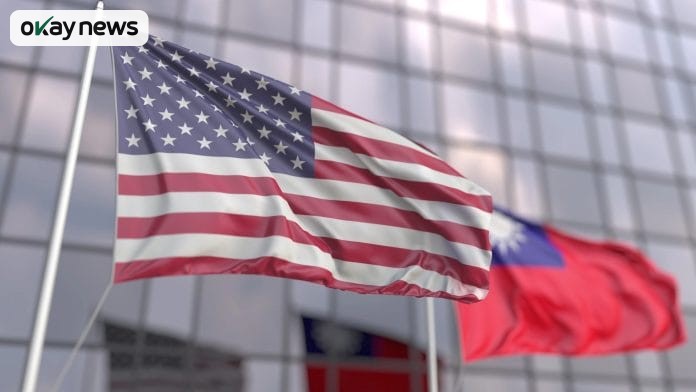
The United States of America and Taiwan have reached a far-reaching trade agreement aimed at lowering tariffs on Taiwanese exports while significantly increasing Taiwanese investment in semiconductor manufacturing within the United States, a move expected to reshape the global technology supply chain.
The agreement was announced on Friday, 16 January 2026, against the backdrop of rising global demand for artificial intelligence technology and ongoing geopolitical tensions in East Asia. Taiwan, officially known as the Republic of China and governed separately from mainland China since 1949, plays a central role in the global semiconductor industry, producing a large share of the world’s most advanced computer chips.
Okay News reports that under the deal, the United States government will reduce tariffs on Taiwanese goods to 15 per cent, down from a previous 20 per cent reciprocal tariff introduced to address trade imbalances and what Washington described as unfair trade practices.
The United States Department of Commerce said the agreement would “drive a massive reshoring of America’s semiconductor sector,” reflecting Washington’s broader effort to reduce dependence on overseas chip production and strengthen domestic manufacturing capacity.
Taiwanese Premier Cho Jung-tai, the head of Taiwan’s executive government, praised the negotiating team for concluding months of discussions with a strong outcome, describing the agreement as a major success.
“These results underscore that the progress achieved so far has been hard-won,” Cho said, adding that negotiators had “delivered a well-executed home run.”
Taiwan’s dominance in semiconductor manufacturing has long been described by analysts as a “silicon shield,” referring to the strategic importance of its chip industry in discouraging military aggression from the People’s Republic of China, whose government in Beijing claims Taiwan as part of its sovereign territory.
However, concerns over a potential conflict across the Taiwan Strait have intensified pressure from the United States and its allies to diversify chip production beyond the island, amid fears that a disruption could cripple global supply chains.
Taiwan’s Minister of Economic Affairs, Kung Ming-hsin, sought to reassure domestic and international audiences that Taiwan would remain central to global chip production despite the expansion of manufacturing capacity in the United States.
“Based on current planning, Taiwan will still remain the world’s most important producer of artificial intelligence semiconductors, not only for Taiwanese companies, but globally,” Kung told reporters on Friday.
He projected that production capacity for advanced artificial intelligence chips would be split approximately 85 per cent in Taiwan and 15 per cent in the United States by 2030, shifting to 80 per cent and 20 per cent respectively by 2036.
China’s Ministry of Foreign Affairs responded sharply, stating that it “resolutely opposes” the agreement, underscoring Beijing’s sensitivity to closer economic and strategic ties between Washington and Taipei.
The agreement must still receive approval from Taiwan’s parliament, which is currently controlled by opposition parties. Some lawmakers have expressed concerns that increased overseas investment could weaken Taiwan’s domestic industrial base.
Cheng Li-wun, chairperson of the Kuomintang party, which favors closer relations with Beijing, warned that expanded Taiwanese investment in United States chip factories could risk “hollowing out” Taiwan’s economy.
In addition to the general tariff reduction, the United States Department of Commerce said sector-specific tariffs on Taiwanese automobile parts, timber, lumber, and wood products would also be capped at 15 per cent, while generic pharmaceuticals and certain natural resources would face no reciprocal duties.
The department added that Taiwanese chip and technology firms are expected to make new direct investments totaling at least $250 billion in the United States to build and expand facilities producing advanced semiconductors and artificial intelligence hardware.
Taiwan’s government also committed to providing credit guarantees of at least $250 billion to support further investment by Taiwanese enterprises, a move aimed at strengthening the United States semiconductor supply chain.
Taiwanese officials confirmed that the new tariff rate would not be added on top of existing duties, easing concerns among exporters who feared a cumulative burden.
Chris Wu, sales director of Litz Hitech Corporation, a Taiwanese machine tool manufacturer, said the tariff reduction was welcome but warned that companies with thin margins would still struggle.
“Of course, it is good that the reciprocal tariff has been lowered to 15 per cent, at least it puts us on par with our main competitors South Korea and Japan,” Wu said. “But there is no way we can absorb the tariff.”
More than half of Taiwan’s exports to the United States consist of information and communications technology products, particularly semiconductors.
United States Secretary of Commerce Howard Lutnick said the broader objective was to relocate a substantial portion of Taiwan’s supply chain to American soil.
“The objective is to bring 40 per cent of Taiwan’s entire supply chain and production to domestically bring it into America,” Lutnick said during an interview with CNBC. “We are going to bring it all over, so we become self-sufficient in the capacity of building semiconductors.”
While the agreement did not name specific companies, it has major implications for Taiwan Semiconductor Manufacturing Company, the world’s largest contract chipmaker, which previously pledged to invest an additional $100 billion in United States facilities.
Driven by soaring demand for artificial intelligence technology, the company’s chips are used globally, including in devices produced by Apple Incorporated and advanced artificial intelligence hardware developed by Nvidia Corporation.
“As a semiconductor foundry serving customers worldwide, we welcome the prospect of robust trade agreements between the United States and Taiwan,” the company said in a statement. “Strengthened trade relations are essential for advancing future technologies and ensuring a resilient semiconductor supply chain.”
Lutnick confirmed that the company has acquired land in Arizona, United States, and may expand its operations there as part of the agreement.
A day before the announcement, United States officials delayed broader semiconductor tariffs while imposing a 25 per cent duty on certain chips intended for export, a move linked to allowing Nvidia to continue selling artificial intelligence chips to China.