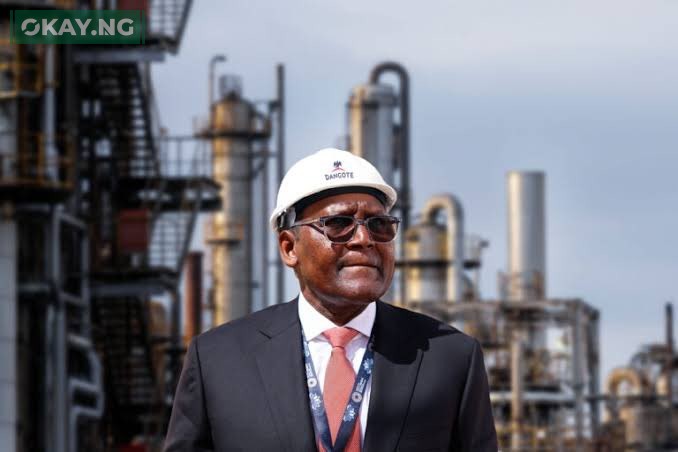
Dangote Oil Refinery has initiated the startup of its polypropylene facility in Lagos, signaling a transformative shift in the domestic market for plastics and textiles. According to reports, the state-of-the-art polypropylene plant is on the cusp of its official unveiling, marking a crucial milestone in the commissioning sequence of the vast refining and petrochemical complex, which has been underway since January 2024.
S&P Global reports that the commencement of operations at Dangote’s 830,000 metric tonnes per year polypropylene site represents one of the final key steps in bringing the ambitious project to full fruition. The news has already sent ripples through the industry. “Polypropylene production has now started, with supplies being distributed in 25kg bags, and has already threatened to upend the domestic market,” two market sources informed Platts, a division of S&P Global Commodity Insights.
The report revealed that the Dangote Group had proactively begun offering polypropylene supplies as early as February, indicating the company’s readiness to swiftly enter the market. Aliko Dangote, the President of the Dangote Group, had previously expressed his expectation that the complex would adequately cover approximately 250,000 metric tonnes per year of Nigeria’s domestic demand for polypropylene, a versatile material widely used in plastic packaging and the textile industry.
Upon reaching full operational capacity, the Dangote facility is poised to become Africa’s largest polypropylene production site, boasting two polypropylene units with capacities of 500,000 metric tonnes per year and 330,000 metric tonnes per year respectively. This scale of production is expected to have a profound impact on the regional market.
S&P Global notes that market participants have cautioned that the new capacity could rapidly capture market share in the existing polypropylene homopolymer market. Currently, this market is primarily served by Indorama Eleme’s Port Harcourt refinery and relies on imports from the Middle East. The entry of Dangote into this space is likely to intensify competition and potentially lower prices, benefiting downstream industries and consumers.
In the oil market, the privately-owned Dangote complex has already demonstrated its ability to significantly undercut local producers, leading to substantial discounts in the gasoline retail market offered by the Nigerian National Petroleum Company Limited. This has disrupted traditional trade routes for oil products, which typically flowed from Europe to West Africa, as the Dangote refinery serves an increasing portion of the domestic market. Simultaneously, NNPC’s recently restarted refineries in Port Harcourt and Warri have experienced operational challenges.
Read Also: Dangote Refinery Nears Full Capacity, Fuel Exports Begin Amidst Supply Chain Hurdles
The Dangote Group had announced in February that the refinery was on track to reach its full 650,000 barrels per day capacity by March, contingent on the availability of crude oil. However, an updated timeline for the petrochemicals site to achieve full utilization has not yet been provided.
Earlier, the company disclosed that its $2 billion petrochemical plant, situated in Ibeju-Lekki, Lagos State, is designed to produce 77 distinct high-performance grades of polypropylene. With an anticipated turnover of $1.2 billion, the Dangote Petrochemical plant, co-located with the refinery, is strategically positioned to meet the growing demands of plastic processing downstream industries across Africa and beyond.
Devakumar Edwin, Group Executive Director, Strategy, Capital Projects & Portfolio Development at Dangote Industries Limited, emphasized the transformative potential of the petrochemical plant. He stated that it would “drive massive investment in the downstream industries, generating huge value addition in the country, creating employment, increasing tax revenues, reducing foreign exchange outflow, and increasing the country’s Gross Domestic Product.”
Edwin highlighted the plant’s significant capacity, noting, “We have 77 types of polypropylene, which can go for different uses that we can produce from our petrochemical plant. Currently, the plant is capable of producing about 900,000 tonnes of polypropylene per annum. Our Petrochemical plant should be the biggest in Africa.”
The local availability of polypropylene is expected to alleviate the challenges faced by manufacturers who currently rely on imported raw materials, often hindered by foreign exchange constraints. “When the raw materials are locally available, there will be many more people who will be willing to invest in the economy. So, it is not just the savings of foreign exchange from petrochemical products’ importation; the country’s downstream sector will also benefit hugely from the availability of petrochemicals in the country,” Edwin explained last year.
Polypropylene, a synthetic fabric derived from petroleum-based thermoplastic polymers, is a versatile material with a wide range of applications. Its source material, propylene gas, is a byproduct of oil and natural gas production. The essential monomer propylene is extracted from crude oil in gas form. Polypropylene is used in numerous products, including plastic packaging, machinery parts, fibers and textiles, piping systems, furniture, and medical equipment.
The commencement of polypropylene production at the Dangote Refinery marks a pivotal moment for Nigeria’s manufacturing sector. By reducing reliance on imports and fostering local production, this development has the potential to stimulate economic growth, create jobs, and enhance Nigeria’s position as a key player in the regional and global petrochemical markets. As a news writer, I see this as a game-changer for our economy, offering a glimpse into a future where Nigeria becomes a hub for industrial innovation and self-sufficiency. The implications for job creation and reduced dependence on foreign exchange are particularly significant, offering hope for a more prosperous future for many Nigerians.