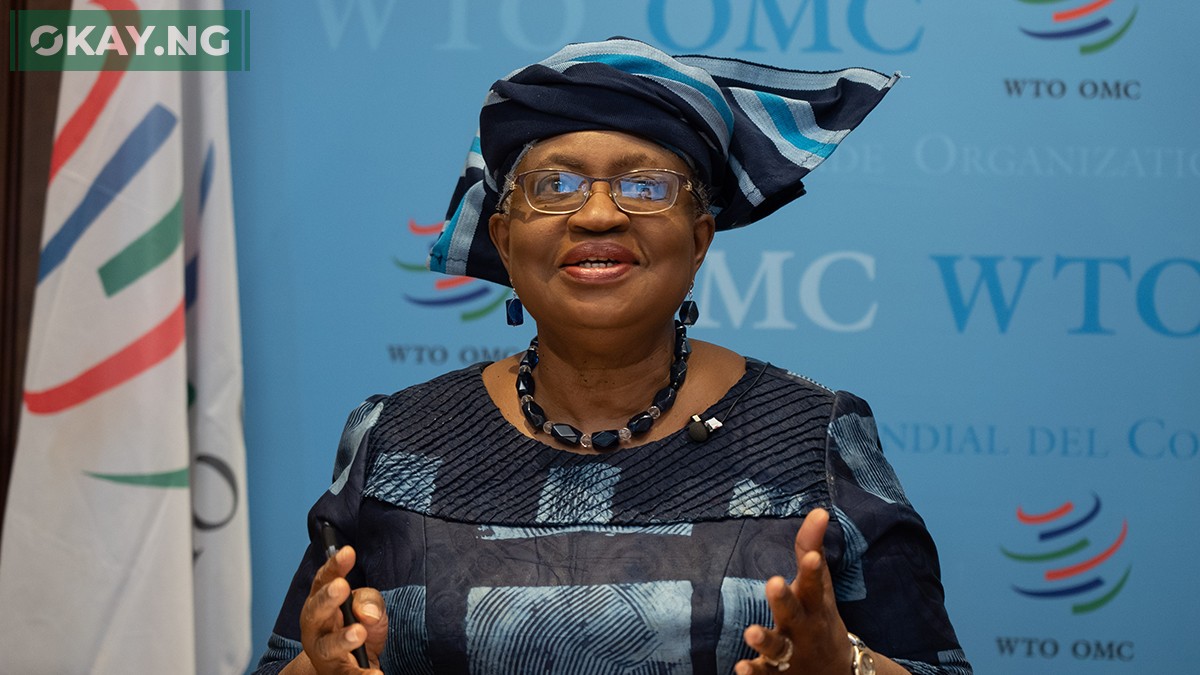
As the ripple effects of newly imposed U.S. tariffs begin to spread across the globe, Africa finds itself at a critical juncture, compelled to accelerate its ambitions for stronger internal trade and decreased reliance on external economic powers. This was the stark warning delivered by World Trade Organization (WTO) Director-General Ngozi Okonjo-Iweala on Friday, speaking on the sidelines of the International Monetary Fund (IMF) and World Bank Spring Meetings in Washington.
While acknowledging that the immediate macroeconomic impact of the April 2 tariffs, enacted by President Donald Trump, might appear limited – with only 6.5% of Africa’s exports destined for the U.S. and a mere 4.4% of its imports originating from the nation – Okonjo-Iweala emphasized a deeper, more systemic vulnerability. “We are not trading much, which is not a good thing,” she told reporters, underscoring the continent’s overall low levels of both internal and external trade. “And within Africa, a handful of countries are very severely impacted.”
The WTO Chief highlighted the precarious situation facing Lesotho, a low-income nation bracing for a potential near-halving of its GDP growth. Lesotho currently exports approximately $200 million worth of textiles to the U.S. while importing a meager $3 million in return. Under the new reciprocal tariff regime, the nation’s outbound goods could face levies as high as 50%.
“If those tariffs are implemented, Lesotho will lose a lot of its exports to the U.S.,” Okonjo-Iweala stated with concern. “Even if it gains a little by exporting elsewhere, the net loss is significant.” This scenario paints a vivid picture of how even seemingly targeted trade policies can disproportionately impact smaller, trade-dependent economies.
The challenges extend beyond Lesotho. West African nations Ghana and Côte d’Ivoire are also bracing for significant headwinds. Ghana faces a 10% tariff, while Côte d’Ivoire, an agricultural powerhouse exporting nearly $1 billion in cocoa to the U.S., now confronts a 21% duty. Okonjo-Iweala cautioned that such measures could destabilize West African economies heavily reliant on a narrow spectrum of exports. “Côte d’Ivoire’s cocoa income will disappear across the border if you have differential reciprocal tariffs,” she warned, highlighting the potential for significant economic disruption.
Read Also: WTO Warns of 80% Trade Collapse Amid US-China Tariff Escalation
While appealing to Washington to consider exemptions for the most vulnerable nations, Okonjo-Iweala’s message carried a strong undercurrent of self-determination. “The message is simply that Africa must become more self-reliant,” she asserted. “Aid is disappearing. We need investment.” This shift in focus underscores a growing recognition that long-term economic stability necessitates home-grown solutions.
The path to greater self-reliance, according to the WTO Director-General, lies in a multi-pronged approach. Mobilizing domestic resources, streamlining often cumbersome regulatory bottlenecks, and, crucially, deepening intra-African trade are paramount. Currently, trade within the continent accounts for a relatively low 16% to 20% of its total commerce, a figure that signifies substantial untapped potential.
“We can’t afford to remain at the mercy of external shocks,” Okonjo-Iweala declared, her tone emphasizing the urgency of the moment. “This is a wake-up call.” Her remarks resonate with a growing consensus among African leaders and economists that fostering stronger continental trade links is not merely an aspiration but a necessity for building resilient and sustainable economies in an increasingly unpredictable global landscape. The new U.S. tariffs, while posing immediate challenges for some, may ultimately serve as a catalyst for the long-overdue strengthening of Africa’s internal economic fabric.