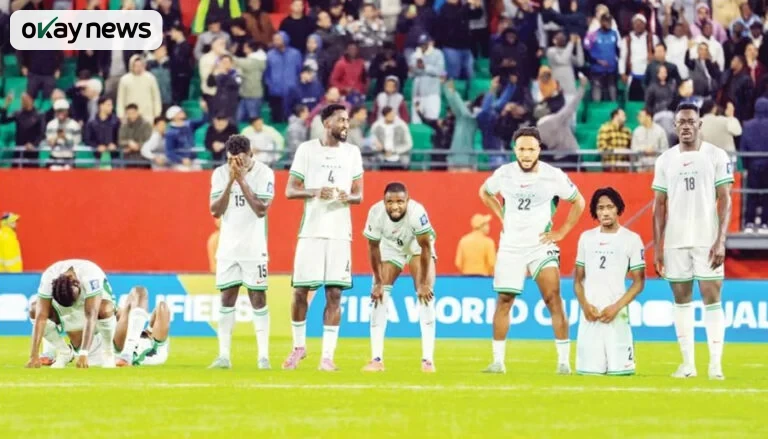
The Football Federation of the Democratic Republic of Congo, the official governing body of football in the Central African nation, has issued a firm response to Nigeria’s recent petition over player eligibility, cautioning the West African country against what it described as an attempt to secure qualification for the 2026 FIFA World Cup through administrative means rather than on-field performance.
The warning followed a petition submitted by the Nigeria Football Federation, the body responsible for football administration in Africa’s most populous country, to the Fédération Internationale de Football Association, the global football governing authority based in Zurich, Switzerland. The petition challenged the eligibility of several Congolese players who featured in a decisive play-off match that ended Nigeria’s qualification hopes.
Okay News reports that the dispute stems from a dramatic play-off encounter held in Morocco, a North African country that served as a neutral venue, where the Congolese national team edged Nigeria’s Super Eagles by a 4–3 margin in a penalty shoot-out. The defeat eliminated Nigeria from advancing to the FIFA intercontinental play-off stage of the 2026 World Cup qualification process.
Following that result, the Democratic Republic of Congo was granted a direct passage into the final of the intercontinental play-off tournament, where the Central African nation is scheduled to face the winner of the semi-final clash between New Caledonia, a Pacific Island territory, and Jamaica, a Caribbean nation.
Controversy emerged after reports suggested that between six and nine Congolese players who had switched national allegiance may not have fully satisfied domestic legal requirements before representing the country. The allegations focused on claims that while the players possessed valid Congolese passports, they may not have formally renounced their previous citizenships, a requirement under Congolese law, which does not permit dual nationality.
Despite these claims, FIFA reportedly cleared the players on the basis that they held legitimate travel documents issued by the Democratic Republic of Congo. However, Nigerian officials argued that the world football body may have been misled during the verification process.
Reacting publicly, the Congolese football federation dismissed the allegations outright. In a strongly worded message shared on the national team’s official X platform account on Wednesday, the federation accused Nigeria of attempting to overturn a sporting result through legal channels.
“If you can’t win on the pitch, don’t try to win from the back door. The World Cup must be played with dignity and confidence — not with legal tricks. Bring it on,” the post stated.
The Congolese football authorities further reinforced their position by sharing images of players who had switched nationality, including Premier League defender Aaron Wan-Bissaka, during official engagements with the President of the Democratic Republic of Congo, Felix Tshisekedi, the country’s current head of state.
Additional visuals obtained from FIFA’s “Change of Association” platform detailed the dates and approvals of nationality switches for several key Congolese players, indicating that the global football authority had formally completed the process.
Earlier in the week, Nigerian football officials confirmed the submission of their petition to FIFA, citing constitutional provisions of the Democratic Republic of Congo that prohibit dual citizenship.
“Nigeria Football Federation has done the needful,” a senior executive board member said. “Their constitution does not allow dual citizenship, and about six to nine players had that status during the play-off. That is the loophole we are exploring. Our lawyers must have submitted the relevant documents to FIFA as well.”
The Nigeria Football Federation General Secretary, Doctor Mohammed Sanusi, also reiterated the country’s stance, maintaining that the issue extends beyond FIFA regulations into domestic legal compliance.
“We are waiting. The Congolese rules say you cannot have dual citizenship or nationality,” Sanusi said. “Wan-Bissaka has a European passport; some of them have French passports, others Dutch passports. The rules are very clear, and we have submitted our petition.
“FIFA rules say once you have a passport of your country, you are eligible, and that is why they were cleared. But our concern is that FIFA was deceived into clearing them. It is not FIFA’s responsibility to enforce Congo’s domestic regulations; FIFA acts based on what is submitted to it. What we are saying is that the process was fraudulent.”
The unfolding situation has revived Nigeria’s hopes of securing a place at the 2026 FIFA World Cup, co-hosted by the United States, Canada, and Mexico. Nigeria previously failed to qualify for the 2022 edition held in Qatar, raising the prospect of missing consecutive tournaments.
The Democratic Republic of Congo, meanwhile, has appeared at the FIFA World Cup only once, in 1974, when the nation competed under the name Zaire.