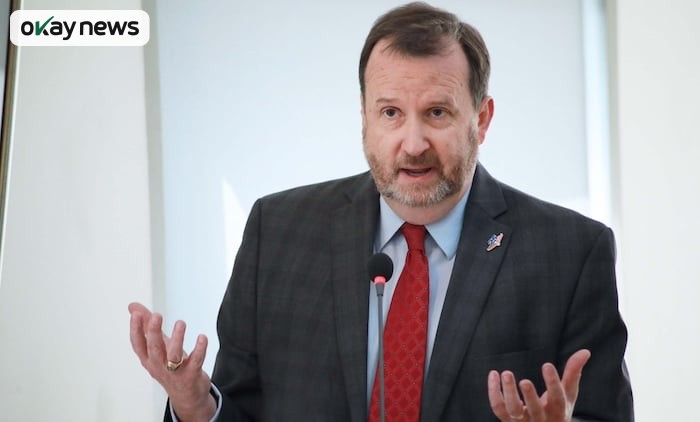
United States President, Donald Trump, has reportedly directed the recall of the United States Ambassador to Nigeria, Richard Mills, alongside several other senior American diplomats serving across different regions of the world.
The development was first reported by Politico, which disclosed that the decision forms part of a broader effort by the Trump administration to realign United States diplomatic representation overseas with the President’s long-standing “America First” foreign policy doctrine. Okay News reports that the move is already generating discussions within diplomatic and policy circles in both Washington and Africa.
A senior official at the United States Department of State confirmed to the news platform that the ambassadors affected by the recall were initially appointed during the administration of former United States President, Joe Biden. According to the official, their ambassadorial tenures are scheduled to formally end in January.
While the recalled diplomats are expected to return to Washington, District of Columbia, United States, the official clarified that they are not being dismissed from the United States Foreign Service. Instead, they may continue their careers in other roles within the State Department if they so choose, even though their assignments as chiefs of mission have now concluded.
Africa emerged as the most affected region in the shake-up, with ambassadors recalled from thirteen countries. These include Nigeria, Africa’s most populous country and largest economy, as well as Burundi, Cameroon, Côte d’Ivoire, Senegal, and Uganda. Other diplomatic posts impacted by the recall span the Asia-Pacific region, Europe, the Middle East, South Asia, and the Western Hemisphere.
In a formal statement addressing the development, the State Department described the recalls as a “standard process in any administration.” The department emphasized that ambassadors serve at the discretion of the President of the United States and are expected to advance the policy priorities of the administration in power.
“An ambassador is a personal representative of the president, and it is the president’s right to ensure that he has individuals in these countries who advance the America First agenda,” the statement said.
Officials further stressed that none of the affected diplomats are losing their employment status, adding that continuity within the Foreign Service remains intact despite the leadership changes at various embassies.
Nevertheless, analysts note that the sudden transition is likely to require operational adjustments within United States embassies and could temporarily affect ongoing diplomatic initiatives in host countries.
For Nigeria, the recall of the United States envoy represents a notable shift in diplomatic engagement at a time when bilateral relations remain significant. The West African nation is a strategic partner to Washington in areas including regional security cooperation, economic engagement, democratic governance, and development assistance.
The move has also attracted concern from some United States lawmakers and the American Foreign Service Association, which represents American diplomats globally, particularly regarding the potential impact on morale and continuity in foreign missions.
The recall was reported on Monday, 22 December 2025, amid heightened scrutiny of United States–Africa relations under the returning Trump administration.