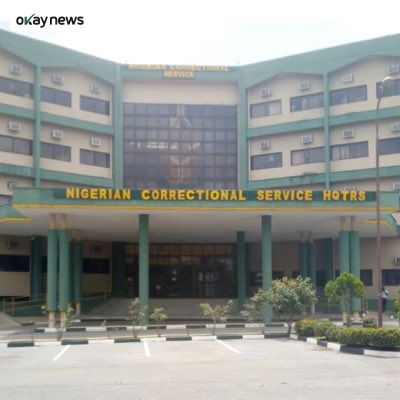
Nigeria’s prison population increased by 11,764 inmates between 2017 and the second quarter of 2025, intensifying pressure on correctional facilities and highlighting persistent challenges in the criminal justice system.
Okay News reports that this rise, from 69,946 inmates in 2017 to 81,710 by Q2 2025, represents a 16.82 per cent growth over the eight-year period, according to new data from the National Bureau of Statistics (NBS) titled “Nigerian Correctional Service Statistics (2017–Q2 2025).”
During the same timeframe, the official capacity of correctional centres expanded from 53,752 to 65,035, a 20.99 per cent increase, but inmate numbers continue to outpace available space in many facilities, leading to severe overcrowding.
A key driver of this trend is the high proportion of unsentenced inmates, with those awaiting trial or on remand growing from 47,610 in 2017 to 53,790 by Q2 2025, a 12.98 per cent rise.
This points to systemic issues such as slow judicial processes, court congestion, limited access to legal representation, and frequent use of detention as a default rather than a last resort.
State-level data reveals stark disparities in prison congestion, with Lagos State recording the highest inmate population at 9,209 in facilities designed for only 4,167 persons.
Other states with significant inmate numbers include Ogun (4,939), Kano (4,667), and Enugu (3,536), while Kogi had the lowest at 530, followed by Bayelsa (696) and Benue (777).
The NBS report also details offence types contributing to prison admissions, with a total of 176,536 inmates admitted nationwide by the end of 2024.
Remand and awaiting-trial cases dominated, accounting for 94,614 admissions, while condemned cases were the fewest at 2,883, indicating death-row inmates form a small portion of the population.
Stealing was the most common offence leading to incarceration, with 55,722 admissions, followed by “other offences” at 46,043 and armed robbery at 10,090.
Offences often associated with high-profile enforcement recorded minimal admissions, including bribery and corruption (27), cybercrime (48), and smuggling (118).
The data underscores deep structural weaknesses in Nigeria’s criminal justice system, where overcrowding stems more from inefficiencies in trials and detention practices than solely from rising crime rates.
Rights groups have long called for judicial reforms, decongestion initiatives, and greater use of non-custodial measures like community service and probation to align the system with international human rights standards.
In August 2025, the Nigerian Correctional Service (NCoS) revealed that 8,246 inmates nationwide were suffering from mental illness, highlighting additional strains on the system.
The NBS findings reinforce the urgent need for comprehensive reforms to address trial delays, improve legal aid access, and reduce reliance on pretrial detention.