Troops of Nigeria’s Joint Task Force (JTF), operating under Operation Hadin Kai, have successfully repelled a drone-coordinated assault launched by the Boko Haram insurgent group in the volatile Timbuktu Triangle area of Borno State in Northeast Nigeria, officials confirmed on Monday.
The development unfolded during a carefully planned advance linked to Operation Desert Sanity, a sustained military campaign designed to locate, dismantle, and eliminate entrenched Boko Haram and Islamic State West Africa Province (ISWAP) cells operating across remote enclaves within the Lake Chad Basin corridor, a region that has witnessed a prolonged insurgency for over a decade.
According to a statement released by the Media Information Officer of the JTF Northeast, Lieutenant Colonel Sani Uba, the troops were advancing after staging a deliberate clearance sweep across identified terrorist camps situated in the communities of Chilaria, Garin Faruk, and Abirma on Sunday.
“The troops advanced from their harbour area and conducted intelligence-led operations targeting terrorist strongholds across multiple enclaves. The operation resulted in the destruction of several camps and the recovery of critical items belonging to the insurgents,” Lieutenant Colonel Sani said.
Air-Ground Coordination Prevents Insurgent Reinforcement
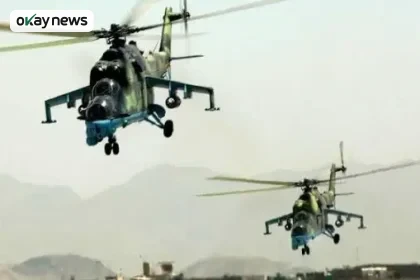
The military confirmed that ground troops were supported by air assets deployed under Operation Hadin Kai, which provided real-time Intelligence, Surveillance and Reconnaissance (ISR) coverage over the operation axis. ISR (Intelligence, Surveillance and Reconnaissance) coverage enabled the tracking of insurgent movements and prevented possible reinforcement from Boko Haram and ISWAP units positioned deeper within the forest terrain.
“The synergy between the air and ground components enhanced precision, boosted troop confidence, and limited the ability of the terrorists to mount counter-attacks,” the statement added.
Okay News reports that air-to-ground ISR coordination has become a defining feature of Nigeria’s modern counter-insurgency strategy, especially since the Nigerian Armed Forces broadened their technological capability to disrupt terrorist mobility corridors in the region.
Drone Attacks Repelled After Intense Firefight
Despite the successful clearance operation earlier in the day, Lieutenant Colonel Sani disclosed that at midday the advancing soldiers came under a sustained armed drone assault launched by the insurgents.
“Despite being attacked by armed drones, the troops maintained momentum and continued their offensive advance. A second attempt by the terrorists in the evening was also decisively repelled, forcing them to withdraw under pressure,” the military official stated.
The Army noted that the confrontations reaffirmed the dominance of the Nigerian military across the Timbuktu Triangle axis, a strategic battlefield zone named after its triangular geography and proximity to historical smuggling routes.
Recovered Weapons And Logistics Supplies
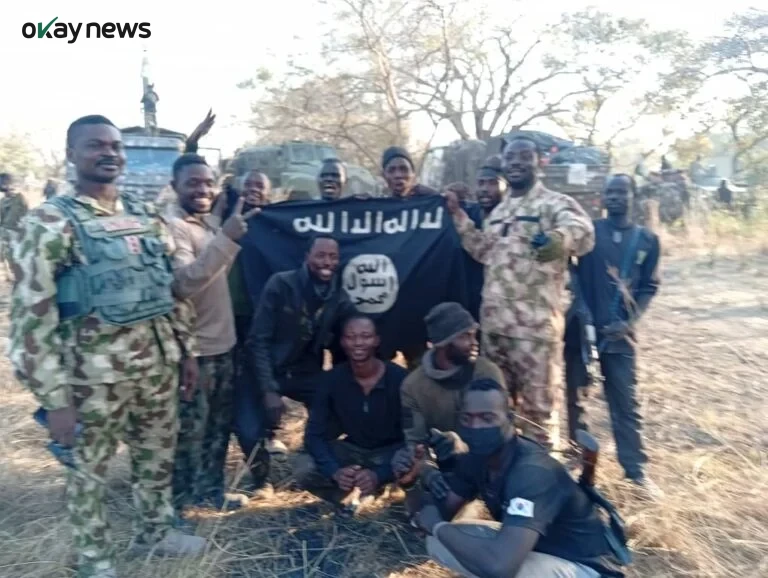
During the operation, troops seized a diverse range of materials classified as military and operational significance. Items recovered included Baofeng radios, mobile phones, five AK-47 rifle magazines, several rounds of 7.62 × 39 millimeter special ammunition, 7.62 millimeter North Atlantic Treaty Organization (NATO) belted ammunition, links of 12.7 × 10⁸ millimeter ammunition, and several Boko Haram and Islamic State West Africa Province flags.
Other recovered materials included diesel-powered grinding machines, a significant quantity of medical consumables, several bags of food grains, a pick-up truck, underground storage facilities used for logistics, and a Petroleum And Oil Lubricant (POL) dump, which the Army said contributed to degrading the terrorists’ battlefield readiness and supply resilience.
Morale And Security Situation
According to Lieutenant Colonel Sani, troop morale remains elevated despite sustained engagements with insurgent factions. He further described the security environment as “calm but unpredictable,” adding that forces remain on heightened alert to prevent future retaliatory attacks.
The Nigerian Military High Command reaffirmed that current operations will continue until the insurgent threat across Northeast Nigeria is eliminated and lasting stability is restored to communities affected by the conflict.
“The military remains resolute in its mission to eliminate terrorist threats, safeguard civilian lives, and restore enduring peace to the region,” the Command stated.
Global And Regional Context
Boko Haram, an extremist organization that originated in Northeast Nigeria in 2002, has been responsible for mass displacement, civilian deaths, and attacks across Nigeria, Cameroon, Niger, and Chad. In 2016, a faction of the group pledged allegiance to the Islamic State group, establishing the Islamic State West Africa Province (ISWAP), which continues to stage attacks and maintain recruitment networks in remote border regions.
International Security Implications
Regional analysts argue that the emergence of drone warfare in insurgent operations poses evolving security challenges for West African military forces. Although non-state drone deployment remains limited, defence experts warn that insurgent adaptation could signal a future shift in asymmetric battlefield tactics within the Sahel and Lake Chad Basin theatres.