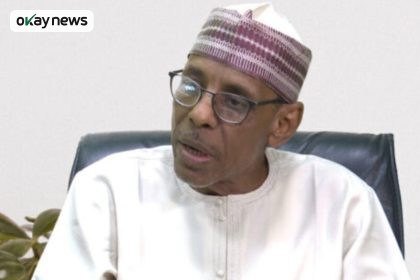
The Federal High Court in Abuja, Nigeria’s capital, on Wednesday, 21 January 2026, removed Julius Abure from his position as National Chairman of the Labour Party (LP), ordering Nigeria’s election management body, the Independent National Electoral Commission (INEC), to recognise a caretaker leadership headed by Senator Esther Nenadi Usman, a former Minister of Finance of the Federal Republic of Nigeria.
Okay News reports that the decision, delivered by Justice Peter Lifu, relied on a previous ruling of the Supreme Court of Nigeria on Friday, 04 April 2025, which the court said affirmed Usman as the valid leader for the purpose of the current interim arrangement in the party.
In the judgement, the court directed INEC to immediately recognise the Senator Nenadi Usman-led Caretaker Committee as “the only valid authority to represent the Labour Party,” pending the time the party holds a national convention to elect substantive officers.
The case before Justice Lifu was filed by Usman and marked THC/ABJ/CS/2262/2025. Julius Abure was named as a defendant, alongside the Nigerian Labour Congress (NLC), Nigeria’s umbrella federation of trade unions, which was also joined in the suit.
Justice Lifu held that materials placed before the court showed Abure’s tenure had already elapsed, rejecting arguments that the dispute should be treated strictly as an internal party issue beyond the court’s reach. The court also held that the caretaker arrangement was “a necessity” arising from the direction and effect of the Supreme Court ruling.
The judgement comes amid a prolonged leadership dispute within the Labour Party, the political platform that fielded Peter Obi, a former Governor of Anambra State in south-eastern Nigeria, as its presidential candidate in Nigeria’s 2023 general election.
According to the case history outlined in court filings, the party’s National Executive Committee (NEC) had earlier moved to remove Abure and set up a caretaker structure. The caretaker body was constituted as a 29-member committee, with Usman as chairperson, following an expanded stakeholders’ meeting hosted in Umuahia, Abia State, a major city in south-eastern Nigeria, by Governor Alex Otti, the Governor of Abia State.
The meeting that led to Abure’s removal from office, the report said, was chaired by Peter Obi, Nigeria’s former Anambra State Governor and the Labour Party’s 2023 presidential flagbearer, who had previously been politically aligned with Abure during the party’s election cycle.
Abure, dissatisfied with the party’s internal decision and the caretaker steps that followed, had earlier approached the Federal High Court in Abuja to validate his continued claim to the chairmanship. In his affidavit supporting Suit No. FHC/ABJ/CS/1271/2024, he argued that he became Acting National Chairman after a National Executive Committee (NEC) meeting in Benin City, Edo State, on Monday, 29 March 2021, and later maintained that subsequent NEC decisions, including a meeting in Asaba, Delta State, on Tuesday, 18 April 2023, reinforced the legitimacy of leadership actions under his watch.
He further told the court that the Labour Party held a national convention in Nnewi, Anambra State, on Wednesday, 27 March 2024, where he said he was lawfully elected as National Chairman. He also cited the party’s participation in governorship elections in Edo State and Ondo State under his leadership as part of his claim to continuing authority.
While Abure initially secured favourable decisions at the Federal High Court and the Court of Appeal, those rulings were later overturned by the Supreme Court of Nigeria, which nullified the lower courts’ concurrent decisions. In the Supreme Court’s lead judgement, prepared by Justice Inyang Okoro, the court allowed the appeal filed by Senator Nenadi Usman and Honourable Darlington Nwokocha, who were listed as chairperson and secretary of the caretaker committee, respectively, and dismissed a cross-appeal filed by Abure.
In addition, the Supreme Court urged political parties to follow their constitutions and internal rules in choosing officers, and advised office-holders whose tenures have expired to vacate their positions when due.