Finland’s military intelligence has warned that the possibility of long-range drones drifting into Finnish airspace is increasing as the war triggered by Russia’s full-scale invasion of Ukraine continues to reshape security conditions around the Baltic region.
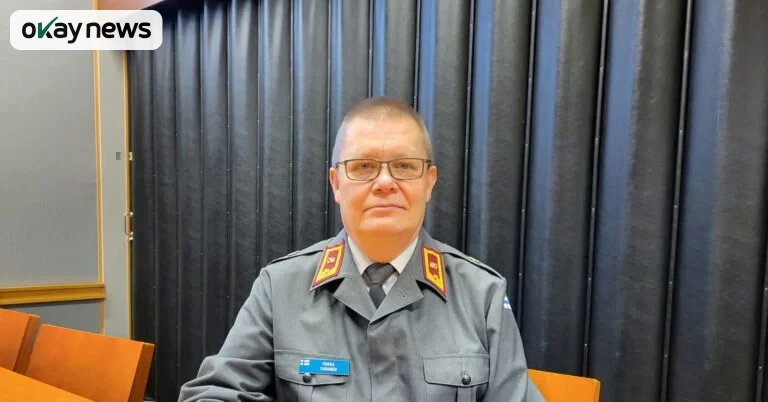
Okay News reports that Major General Pekka Turunen, Chief of Finnish Defence Intelligence, raised the concern during an interview held ahead of the planned release on Thursday, 22 January 2026, of a Finnish military intelligence assessment updating the country’s security outlook.
Finland, a Nordic country in Northern Europe, shares a 1,340-kilometre border with the Russian Federation, and has closely monitored spillover risks linked to fighting in Ukraine, including activity around the Gulf of Finland, a strategic inlet of the Baltic Sea bordered by Finland and Estonia, with Russia’s Saint Petersburg region at its eastern end.
One issue highlighted in the new report is the chance that long-range drones could be diverted off course and unintentionally enter Finland.
“The risk of a drone drifting into Finnish airspace or onto Finnish territory is growing all the time, the more Ukraine strikes in this area near the Gulf of Finland,” Turunen said.
He explained that Ukraine’s strikes on energy and port infrastructure in Russia, including oil facilities close to Finland, have prompted Russian countermeasures that may interfere with drone navigation.
“Ukraine has been targeting these oil ports… quite close to Finland and now we know how Russia is countering them by using GPS jamming, so if a drone was using GPS for navigation to reach its target, it could be diverted somewhere else through this jamming,” he said, referring to the Global Positioning System (GPS), a satellite-based navigation technology.
Turunen added that Finland has not recorded any such incidents so far.
While noting that Finland’s broader security environment has worsened since the war began in 2022, the intelligence service said the overall situation has remained largely similar to what it was a year earlier.
“The military threat has not increased,” he said.
Finland’s strategic posture has shifted sharply since the start of the conflict. After decades of military non-alignment, the country applied to join the North Atlantic Treaty Organization (NATO) and became a member in April 2023, a move that expanded the alliance’s direct border with Russia.
Turunen also linked recent political tensions involving the United States and Europe to how Russia may interpret Western unity. He said the political turmoil that followed United States President Donald Trump’s push to seize Greenland, an autonomous territory within the Kingdom of Denmark, was likely encouraging Russia to act “more freely,” as global attention appeared to drift away from Ukraine.
He spoke before Trump announced on Wednesday that he was scrapping tariffs against Europe and ruling out military action to take Greenland from Denmark.
“At least on a political level, it has probably had an encouraging effect on Russia,” Turunen said.
“In other words, Russia sees this political climate as a sign that the West, NATO, and Europe are in disarray, on the brink of collapse,” he continued.
Trump had previously threatened European nations with tariffs for opposing his plans to acquire Greenland, a stance that drew anger from Brussels, the de facto capital of the European Union, and raised fresh questions about cohesion within NATO at a time when European governments have sought to keep focus on support for Ukraine and deterrence against Russia.