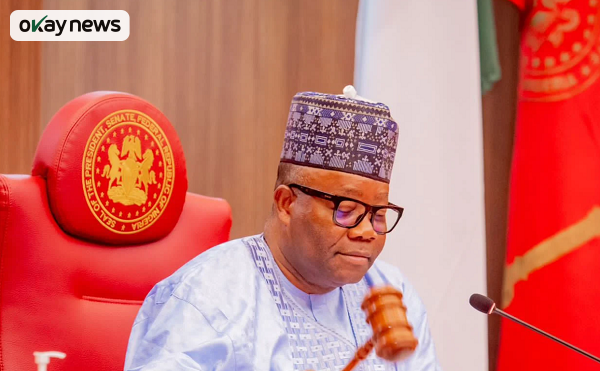
Nigeria’s Senate President, Godswill Akpabio, has moved to calm concerns over the authenticity of new tax laws that began taking effect in January, saying the legislation was not altered after parliament approved it.
Speaking during plenary on Wednesday, 28 January 2026, in Abuja, Nigeria’s capital, Akpabio dismissed claims that different versions of the laws were being circulated outside the official documents agreed by lawmakers.
“I understand that there is another version that was circulating around, which was not in compliance with what was contained in our votes and proceedings,” he said, referring to the formal record of decisions taken by Nigeria’s National Assembly, the country’s federal parliament made up of the Senate and the House of Representatives.
Akpabio insisted the approved text remains the only valid one. “There is no adulteration. So I mean, at this stage now, you can feel bold enough to discard anything that is to the contrary,” he told senators.
He explained that the reforms are contained in four separate Acts and said the official copies have already been completed through the final legal steps, including publication in the government gazette. Okay News reports that Akpabio said the Acts were signed by Nigeria’s President, Bola Ahmed Tinubu, and certified by the Clerk to the National Assembly, the senior official responsible for authenticating legislative documents.
To prevent further confusion, Akpabio directed the Clerk of the Senate to distribute the gazetted copies of the Tax Reform Acts to all senators.
“So every senator is expected to go home with one today. And then those who are not here, we will distribute them directly to the senators,” he said.
He added that distribution would be tightly controlled to avoid unauthorised copies spreading. “This Act should not be given to any other person. It must be given by the Clerk to the Senate and certified by the Clerk of the National Assembly to avoid any confusion,” Akpabio said.
Akpabio also linked the certification process to the steps taken in both chambers of parliament and the joint efforts used to align final texts where the Senate and House of Representatives had worked on related versions. “So, you take it directly from us. This has taken cognisance of what happened in the House of Representatives, in the votes and proceedings. And also what happened in the Senate and what happened in the Committee on Harmonisation, and signed by Mr President,” he added.
During the same sitting, the Senate delayed consideration of a report from its Committee on Electoral Matters to give lawmakers more time to review it.
Nigeria’s Senate Leader, Opeyemi Bamidele, said the committee chairman, Senator Simon Lalong, was not immediately available, and noted that copies of the report were already in circulation among senators.
“But copies have been circulated. We will allow senators to go home with the report and study it, and when we come tomorrow, we will hold a brief closed-door session and debate the critical clauses of the bill and pass it,” Bamidele said.
Akpabio supported the decision to slow down the process, saying the chamber should not rush work that could affect the country’s democratic system and electoral rules.
“We don’t need to rush the report. We will take our time and do the needful, and ensure justice is done for all and sundry,” he said.