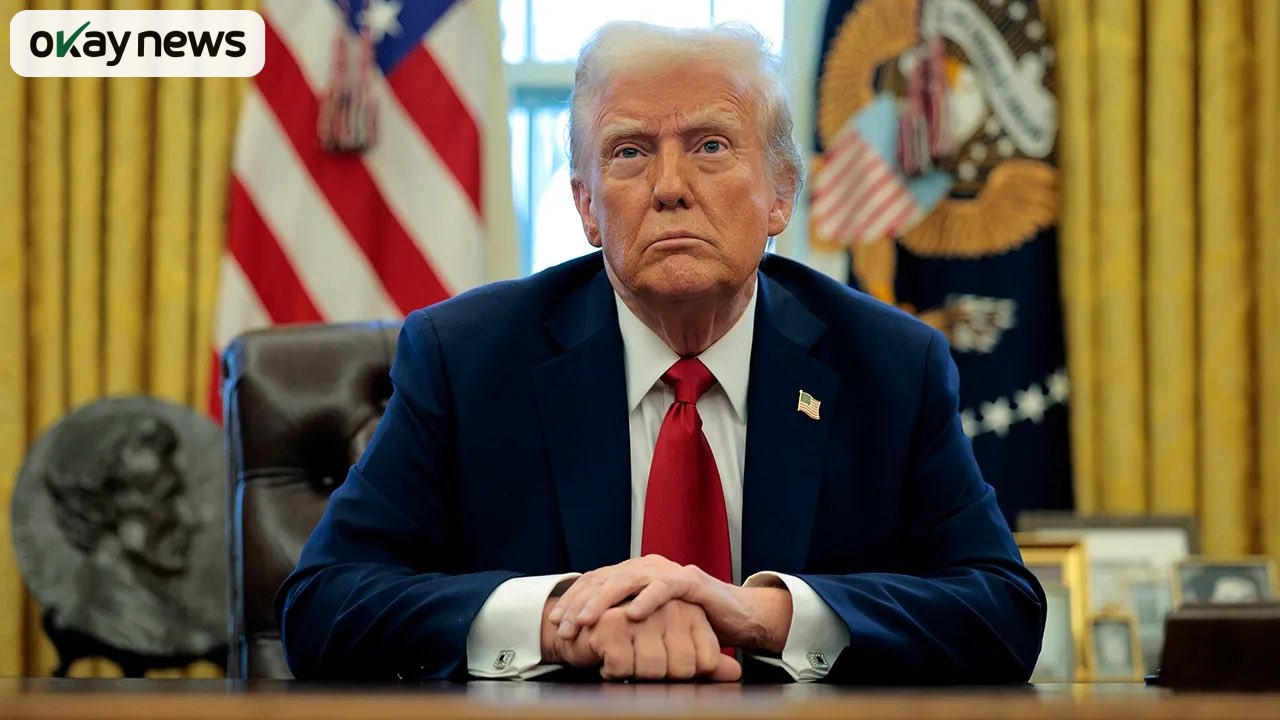
United States President Donald Trump said on Sunday, 1 February 2026, that he was still hopeful of reaching an agreement with Iran, even after Ayatollah Ali Khamenei warned that any United States military attack on the Islamic republic would ignite a broader conflict across the region.
The comments came amid a sharp rise in tensions between Washington and Tehran, after Iranian authorities responded with deadly force to weeks of anti government protests that peaked in January 2026. Okay News reports that the demonstrations began over frustration about the high cost of living, before growing into a large anti government movement.
In Tehran, Iran’s capital, Khamenei described the recent unrest as a “coup” and said the country had already put it down.
“The Americans should know that if they start a war, this time it will be a regional war,” Khamenei said, urging Iranians not to be frightened by Trump’s public warnings.
He also claimed that protesters attacked police and state facilities, as well as banks and mosques, and he said copies of the Koran were burned during the unrest. “It was like a coup,” he said, adding that “the coup was suppressed.”
Trump, speaking to reporters on Sunday, dismissed Khamenei’s warning as expected rhetoric, but said he still wanted to see diplomacy succeed.
“Hopefully we’ll make a deal. If we don’t make a deal, then we’ll find out whether or not he was right,” Trump said.
In recent days, Trump has threatened military action and ordered the dispatch of an aircraft carrier group to the Middle East, a strategic region that includes Iran and several United States allies.
Against that backdrop, Iranian officials signalled that they were watching for mistakes that could push both sides into open conflict. Iran’s Foreign Minister Abbas Araghchi said he was worried about “miscalculations,” but added that he believed Trump was “wise enough to make the correct decision.”
Araghchi said Iran no longer trusts the United States as a negotiating partner, but suggested that some countries in the region were acting as intermediaries to rebuild confidence.
“So I see the possibility of another talk if the United States negotiation team follows what President Trump said, to come to a fair and equitable deal to ensure that there is no nuclear weapons,” he said during an interview with CNN.
As the political dispute deepened, the Iranian government also moved to ease pressure in one closely watched legal case. Iranian authorities ordered the release on bail of 26 year old protester Erfan Soltani, according to his lawyer.
Washington had earlier warned that Soltani was on death row and said the United States would respond harshly if any detained protesters were executed. Iranian authorities insisted he had never been sentenced to death and said the charges against him did not carry the death penalty.
Iran’s judiciary had said Soltani was arrested in January 2026 on accusations linked to propaganda against Iran’s Islamic system and acting against national security.
Iran And Western Governments Clash Over Death Toll And “Terrorist” Labels
Iran has acknowledged thousands of deaths during the protests. On Sunday, Iran’s presidency published a list of 2,986 names out of the 3,117 people it said were killed in the unrest. The presidency said 131 people had not yet been identified, and that their details would be released later.
Iranian authorities have said most of those killed were members of the security forces and civilians caught in the violence, while blaming the unrest largely on what they called “terrorist acts.”
However, the United States based Human Rights Activists News Agency said it had confirmed 6,842 deaths, with most of those it counted described as protesters.
The events have also triggered new diplomatic punishment and retaliation. The European Union listed the Islamic Revolutionary Guard Corps (IRGC) as a terrorist organisation, and Iranian lawmakers responded on Sunday by applying the same label to European armies.
State television footage showed Iranian lawmakers wearing green uniforms associated with the Guards in a show of solidarity, while chanting slogans including “Death to America,” “Death to Israel,” and “Shame on you, Europe.”
It was not immediately clear what practical effect Iran’s move would have. Similar terrorist designations have already been enacted by the United States, Canada, and Australia.
Rising Fear At Home, Mixed Signals On Talks
Inside Iran, some citizens said the heated rhetoric was causing deep anxiety. A 43 year old homemaker, Firouzeh, who did not give her full name, said she felt “very worried and scared.”
“Lately, all I do is watch the news until I fall asleep. Sometimes I wake up in the middle of the night to check the updates,” she said.
An Islamic Revolutionary Guard Corps (IRGC) official, Ahmad Vahidi, was quoted by Mehr News Agency as saying that Iran’s “enemies” were trying to create a “war atmosphere.”
At the same time, other senior figures suggested that communication channels were still open. Ali Larijani, head of Iran’s Supreme National Security Council, said on Saturday, 31 January 2026: “Contrary to the hype of the contrived media war, structural arrangements for negotiations are progressing.”
Trump also confirmed that dialogue was taking place, while maintaining his earlier warnings, saying, “We’ll see what happens.”
The United States president has previously said he believes Iran would rather agree to limits on its nuclear and missile programmes than face military action. Iran, for its part, has said it is prepared for nuclear talks if its missile and defence capabilities are not included on the agenda.