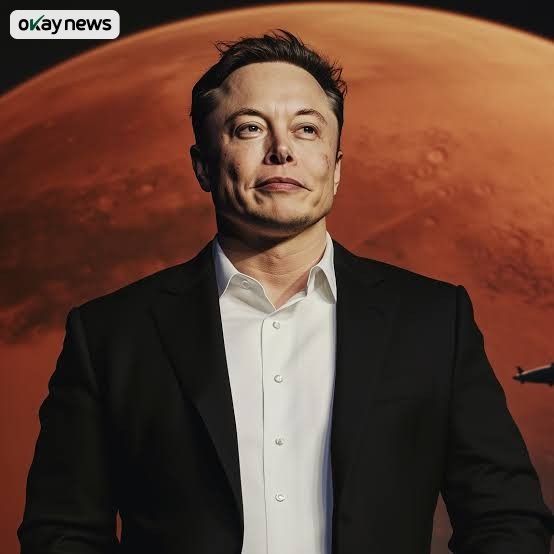
Elon Musk, a United States technology billionaire and the founder of Space Exploration Technologies Corp., known as SpaceX, says the company has shifted its main attention to building a “self-growing city” on the Moon, Earth’s only natural satellite.
Musk made the claim in a post on X, the social media platform he owns, on Monday, 9 February 2026.
Okay News reports that Musk argued the Moon offers a faster path because missions can be repeated more often than trips to Mars, the planet often called the Red Planet.
He said launches to the Moon could happen about every 10 days, with a travel time of about two days, while Mars missions are only possible when the planets align about every 26 months and can take about six months to complete.
“For those unaware, SpaceX has already shifted focus to building a self-growing city on the Moon, as we can potentially achieve that in less than 10 years, whereas Mars would take 20+ years,” Musk wrote.
He also said the company’s long-term goal has not changed. “The mission of SpaceX remains the same: extend consciousness and life as we know it to the stars,” he added.
Musk said the timing of Mars launches is a major obstacle because travel is most practical only during specific orbital windows. In his view, the Moon’s closer distance and more frequent launch opportunities would allow SpaceX to test, improve, and build faster.
Even with the new emphasis, Musk said SpaceX still intends to pursue Mars. He said the company would also work toward a Mars city and begin efforts in about five to seven years, but insisted the Moon remains the quicker priority for what he described as protecting the future of civilisation.
SpaceX has faced long-running doubts about its schedules for human settlement beyond Earth. Critics have often said Musk’s timelines are too ambitious and have pointed to earlier forecasts that were later adjusted.
In 2016, Musk said humans could reach Mars as early as 2024, depending on funding and technical readiness. He also earlier told The Wall Street Journal in 2011 that SpaceX astronauts could reach Mars in a “best case” of 10 years and a “worst case” of 15 to 20 years.
The renewed push toward the Moon comes as United States space policy has shifted again under the administration of United States President Donald Trump. Musk referenced an executive order issued late last year, which stated that the United States wants to return astronauts to the Moon by 2028 under the National Aeronautics and Space Administration’s Artemis programme, a major government-led effort aimed at sending crews back to the lunar surface.
SpaceX is a major contractor on Artemis, including work tied to the lunar lander, the spacecraft meant to carry astronauts from lunar orbit down to the Moon’s surface and back.
The executive order marked a change from Trump’s earlier public goal of sending Americans to Mars within a single four-year term.
NASA currently plans to return astronauts to the Moon’s surface in mid-2027 as part of the Artemis 3 mission, although that schedule has been moved several times. Industry analysts have also warned that more delays are possible, pointing to the unfinished lunar lander being developed by SpaceX.