


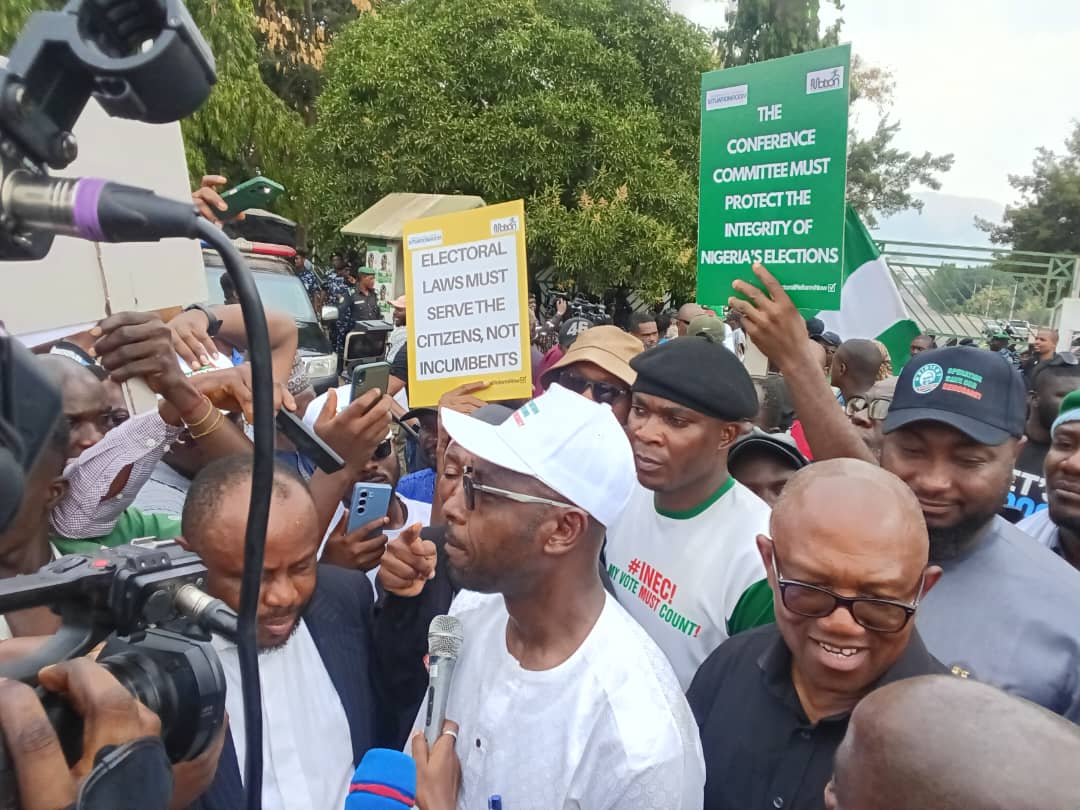
Former Nigerian presidential candidate Peter Obi joined demonstrators at the National Assembly in Abuja on Monday to oppose the Senate’s handling of proposed changes to the country’s election laws, particularly provisions governing the electronic transmission of election results. The protest focused on concerns that lawmakers have weakened reforms intended to improve transparency and public confidence in future elections.
The protesters, drawn from civil society organisations, opposition political parties, human rights groups, and advocacy networks, gathered around the parliamentary complex carrying placards calling for urgent legislative action. Their messages demanded that electronic transmission of results be made compulsory and warned lawmakers against policies they believe could undermine democratic safeguards during elections in Africa’s most populous country.
Okay News reports that the protest follows mounting controversy over amendments to Nigeria’s Electoral Act, originally passed in 2022, which governs how votes are counted, collated, and transmitted by the Independent National Electoral Commission (INEC), the body responsible for organising elections nationwide. Labour unions and professional bodies say public records indicate that a proposal requiring real-time electronic transmission of results from polling units to INEC’s central portal was not adopted by the Senate.
Under the disputed amendment, presiding officers at polling units would have been legally required to upload signed result sheets immediately to the INEC Result Viewing (IREV) portal after votes were counted. Instead, the Senate reportedly retained existing language that allows results to be transmitted “in a manner as prescribed by the Commission,” a phrasing critics argue leaves too much discretion and creates room for uncertainty and disputes.
Nigeria’s largest labour federation, the Nigeria Labour Congress (NLC), has warned that the lack of clarity could destabilise the electoral process. Its president, Joe Ajaero, said conflicting explanations from lawmakers had deepened public anxiety and cautioned that failure to mandate real-time electronic transmission could trigger nationwide protests or even an election boycott by workers and citizens.
The Nigerian Bar Association (NBA), the country’s main professional body for lawyers, has also urged lawmakers to reverse course. At a recent National Executive Council meeting in Maiduguri, the association adopted a position calling on the National Assembly to explicitly compel electronic transmission of results, arguing that ambiguity in election laws poses a serious threat to democratic credibility.
However, Senate President Godswill Akpabio has rejected claims that lawmakers removed electronic transmission entirely from the law. Speaking in Abuja, he said the Senate only deleted the phrase “real time,” insisting that electronic transmission remains legally permissible. The disagreement has kept pressure on legislators, with activists and political figures warning that the final version of the amended Electoral Act will shape public trust in Nigeria’s 2027 general elections.