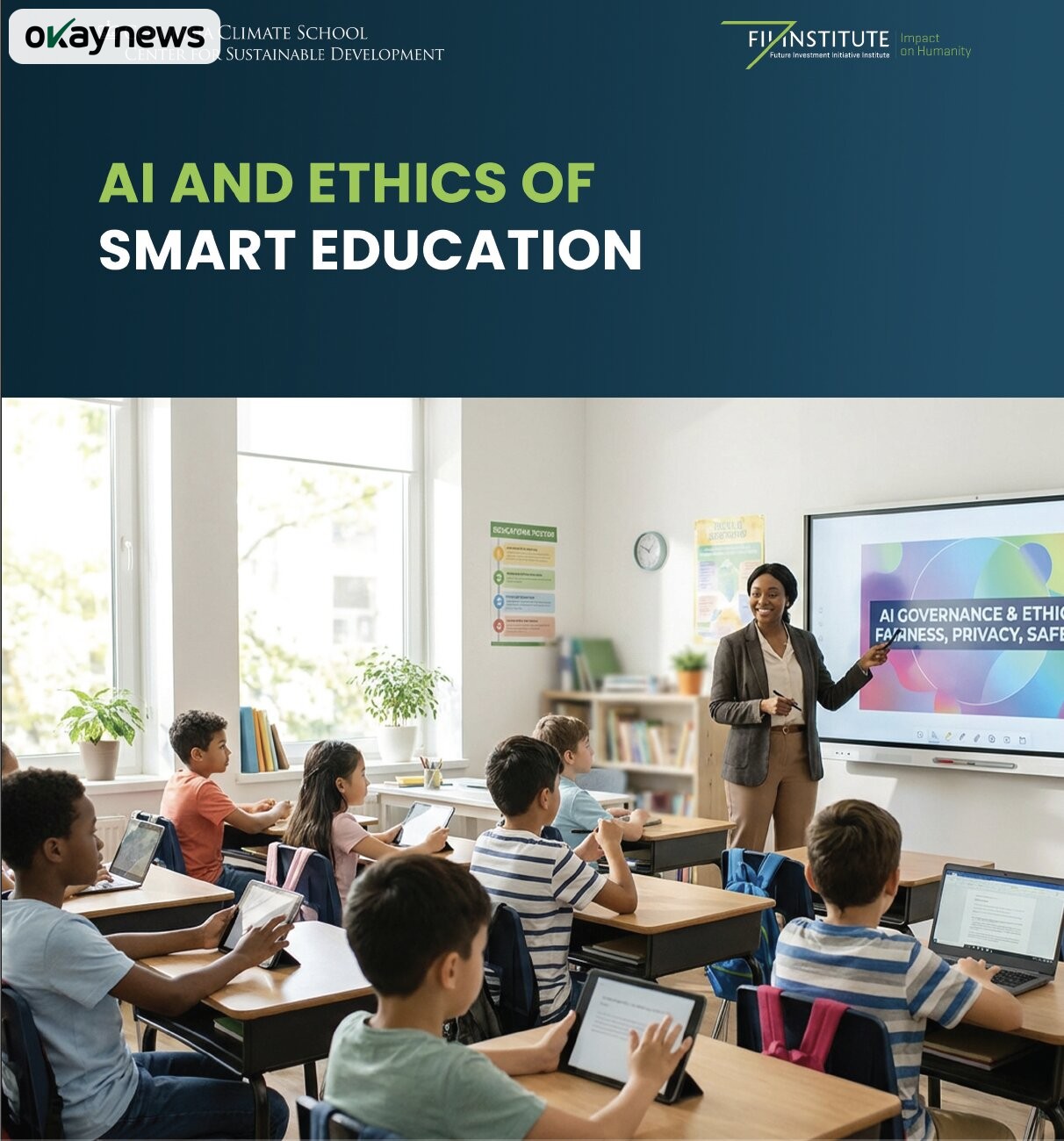
The FII Institute and Columbia University have released a major new study titled AI and the Ethics of Smart Education, warning that the global rush to deploy artificial intelligence in schools could reshape childhood in ways that governance systems are not yet prepared to manage.
The report compares how six countries are integrating AI into education and concludes that the ethical outcomes of smart education depend less on the technology itself and more on how it is governed.
According to the executive summary, artificial intelligence is “rapidly reshaping education systems worldwide,” but the risks are uniquely concentrated in classrooms because children represent a vulnerable population and AI-assisted decisions can influence long-term life trajectories.
Warning Over ‘Datafication of Childhood’
One of the report’s most striking findings is its warning about what it describes as the “datafication of childhood.” Across case studies, researchers found that smart education systems increasingly rely on continuous data extraction, building persistent learner profiles that could follow students well beyond school years.
The study cautions that retention limits and deletion rights for minors remain weakly operationalized in many systems. Without strict safeguards, digital dossiers containing behavioral, academic, and biometric data could extend into adulthood.
It also questions the effectiveness of the widely used “human in the loop” safeguard. The report argues that human oversight becomes meaningless if teachers lack real authority to override AI outputs. In several jurisdictions, administrative and procurement pressures risk turning educators into compliance moderators rather than decision-makers.
Generative AI Framed as Child Safety Issue
The study moves beyond traditional privacy concerns to frame generative AI risks as matters of child safety and school integrity. Researchers highlight the growing threat of deepfakes, misinformation, hallucinated content, harassment, and academic misuse.
The report states that “GenAI introduces misinformation and hallucination risks that undermine learning reliability,” adding that deepfake-enabled bullying is emerging as a serious safety concern in schools. Governance frameworks, it argues, must treat AI in education not only as a privacy issue but also as a safety and integrity challenge.
Governance Models Shape Outcomes
A central conclusion of the report is that governance architecture determines outcomes more than the underlying technology. The same AI tools can produce very different effects depending on whether a country follows a rights-based regulatory model, a state-led strategic integration model, or a fragmented, market-driven approach.
The study categorizes the six countries into three broad pathways.
In France, representing the European Union’s rights-based model, educational AI is increasingly classified as high risk under regulatory frameworks such as the AI Act and GDPR. This approach emphasizes transparency, data minimization, and strong protections for minors.
Qatar treats AI in education as national infrastructure, linking it to human capital and digital sovereignty. The report highlights Qatar’s Arabic-first AI strategy, which frames language capability as a structural fairness issue rather than a mere localization feature.
Brazil’s state of Paraná illustrates the risks of rapid deployment without clear safeguards. Facial recognition and emotion analysis tools entered public schools before comprehensive rules were in place, raising concerns about surveillance and biometric data collection.
China is described as pursuing a highly coordinated national “smart education” push, integrating AI across teaching and administration with strong central alignment, though regional disparities persist.
Japan advances a Society 5.0 vision, emphasizing a human-centered approach that integrates AI literacy, wellbeing, and responsible innovation.
The United States is characterized by rapid adoption under fragmented governance. With policies largely determined at state and district levels, student safety and privacy protections vary widely, exposing schools to uneven safeguards.
Education as a High-Risk AI Domain
Across all jurisdictions, the report classifies education as a high-risk AI domain. Schools concentrate multiple high-stakes uses simultaneously, including grading, placement, predictive analytics, tutoring, and behavioral monitoring.
Errors or bias in these systems can directly shape social mobility, access to opportunity, and long-term outcomes. Because learners are minors, the report argues that education requires safeguards stronger than those applied in most other sectors.
The authors conclude that smart education is ultimately a governance challenge rather than a technical one. Without enforceable standards, AI risks entrenching inequality, normalizing surveillance in childhood, and weakening trust in learning institutions. If governed responsibly, however, it could enhance inclusion, strengthen human development, and support national resilience.