



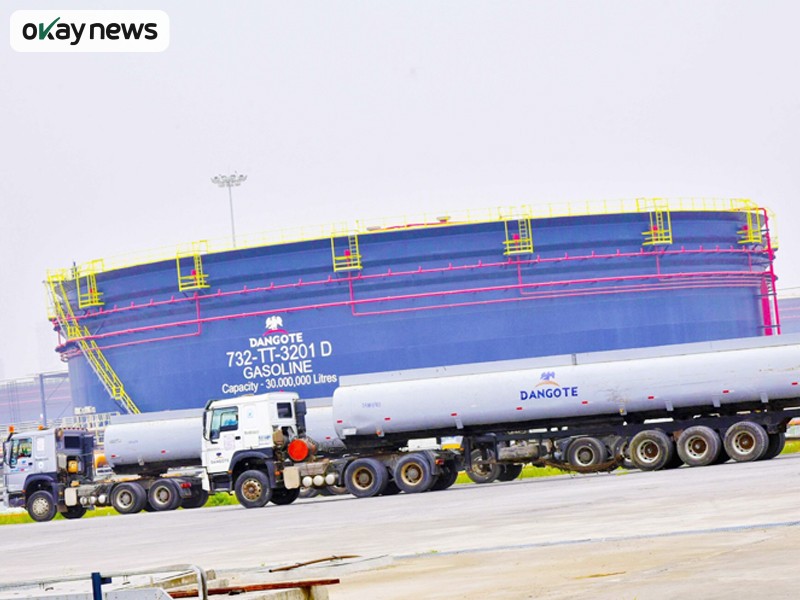
Lagos, Nigeria – The Dangote Petroleum Refinery delivered an average of 40.1 million litres of petrol daily in January 2026, marking a significant increase in domestic fuel supply, according to data from the Nigerian Midstream and Downstream Petroleum Regulatory Authority (NMDPRA).
Okay News reports that the figures represent an increase of about eight million litres per day compared to the 32 million litres recorded in December 2025. The growth signals a steady ramp-up in local refining capacity as Africa’s largest refinery moves closer to covering a larger share of national fuel demand.
The regulatory authority’s report shows Nigeria’s domestic supply benchmark for petrol stands at 75 million litres daily. Average consumption in January stood at 60.2 million litres per day. Imports from the Nigerian National Petroleum Company and other marketers averaged 24.8 million litres daily, bringing total supply into the domestic market to 64.9 million litres per day. The regulator noted that consumption figures are based on volumes trucked out, serving as the key metric for measuring effective fuel distribution.
The refinery, located in the Lekki Free Zone east of Lagos, is designed as a 650,000 barrels-per-day single-train facility, making it the largest of its kind globally. It has been under phased ramp-up since commissioning, with the goal of reducing Nigeria’s dependence on imported petrol. In December 2025, the refinery projected it could supply up to 50 million litres of petrol daily between December and January.
Management has optimised its Crude Distillation Unit and Motor Spirit production block, stabilising steady-state operations. A 72-hour performance test run is currently underway with technology licensor UOP to validate operational efficiency and confirm compliance with global standards.
Prominent investor Femi Otedola recently projected the naira could strengthen to below N1,000 per dollar before year-end, citing reduced import demand and the refinery’s operational milestone. The latest production figures indicate Nigeria is moving closer to achieving its domestic supply targets.




)