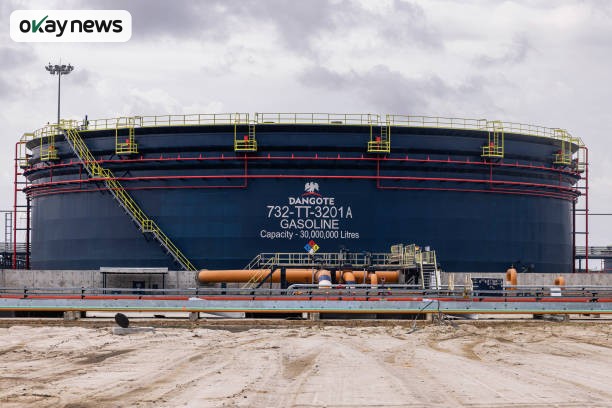
Lagos, Nigeria – Africa’s largest oil refinery has reached its full designed capacity of 650,000 barrels per day (bpd), a milestone its operators say ends Nigeria’s decades-long dependence on imported petroleum products and positions the country as a future net exporter.
Okay News reports that the Dangote Petroleum Refinery achieved the target following the successful optimisation of its Crude Distillation Unit and Motor Spirit production block. The facility, located in the Lekki Free Trade Zone east of Lagos, is now conducting a 72-hour performance validation with its United States-based technology partner, UOP, to certify that all operational parameters meet global standards.
David Bird, Chief Executive Officer of the Dangote Refinery, said the facility’s processing units are now operating steadily at full nameplate capacity. “Our teams have demonstrated exceptional precision and expertise in stabilising both the CDU and MS Block, and we are pleased to see them functioning at optimal efficiency,” Bird said. He added that remaining processing units will undergo performance test runs beginning next week.
The refinery disclosed that it supplied between 45 million and 50 million litres of Premium Motor Spirit, or petrol, daily to the Nigerian market during the recent festive period. With full capacity now achieved, it said it can deliver up to 75 million litres daily as required.
For Nigeria, the milestone carries significant economic implications. The country has historically imported over 80 percent of its refined fuel requirements, spending billions of dollars annually and suffering recurring shortages despite being one of Africa’s largest crude oil producers. Analysts estimate that full domestic refining capacity could save Nigeria approximately $10 billion yearly in foreign exchange, strengthen the naira, and stabilise fuel supply, potentially ending the long queues that have become familiar at petrol stations nationwide.
The achievement follows a pattern of rapid expansion. In October 2025, Aliko Dangote, chairman of the parent conglomerate, announced plans to further increase capacity to 1.4 million bpd, a move that would surpass India’s Jamnagar refinery, currently the world’s largest. The planned expansion would also boost annual polypropylene output and support additional petrochemical investments.
What happens next depends on sustained crude supply and continued operational stability. Phase two performance testing is scheduled to begin next week, and the company says it remains on track to transform Nigeria from a fuel-importing nation into a regional export hub.