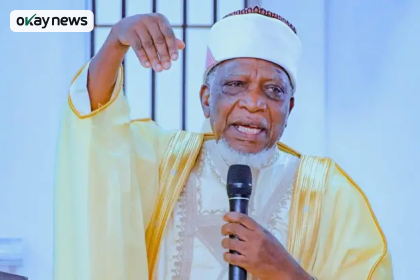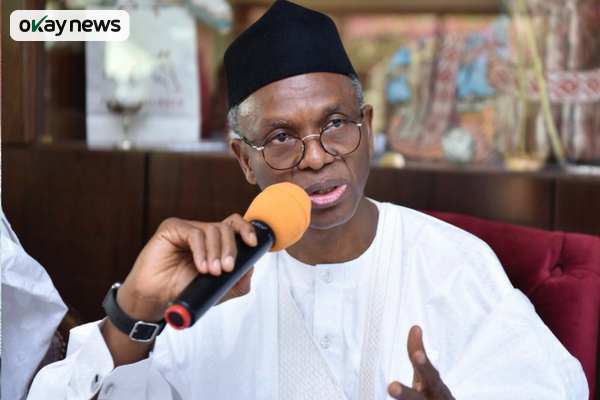
Nasir Ahmad El-Rufai, a former Governor of Kaduna State in north-west Nigeria and a former Minister of the Federal Capital Territory, has rejected claims that he has had a personal fallout with President Bola Ahmed Tinubu, Nigeria’s president and commander-in-chief. He said the two men were never close in the first place.
Speaking in an interview aired on Trust Television on Monday, February 9, 2026, El-Rufai said his support for Tinubu during Nigeria’s 2023 presidential election was based on political calculations within the ruling All Progressives Congress, not friendship.
“I was never Tinubu’s friend. We never had a personal relationship like the one I had with General Buhari of blessed memory,” he said.
El-Rufai explained that his role in Tinubu’s rise was shaped by internal consultations and wider bargaining within the All Progressives Congress (APC), Nigeria’s governing political party. Okay News reports that El-Rufai linked his decision to support Tinubu to a push for a candidate from southern Nigeria after the end of former President Muhammadu Buhari’s eight-year tenure.
“I was approached by certain Islamic stakeholders from the southwest to support the emergence of a southwest Muslim presidential candidate. That is how the discussions started,” El-Rufai stated.
He said there was an expectation inside the APC that power would rotate to southern Nigeria, a political practice often described in Nigeria as “zoning”, where parties try to balance presidential power between the north and the south over time.
“As governor of Kaduna and one of the founders of APC, I knew there was an understanding that after eight years of Buhari, power would return to the south. It wasn’t about Tinubu; he was merely an accidental beneficiary,” he said.
El-Rufai added that once Tinubu won the APC presidential ticket, he campaigned for him out of party loyalty, regardless of personal feelings.
“It is a principle of mine to fight for the candidate of my party in every election, whether I like the candidate or not. The fact that he emerged as the party’s candidate meant I would give everything to ensure he won.”
However, El-Rufai said deeper differences surfaced after the election, which he framed as a clash of values about leadership and public service. He said the issue was not a personal quarrel, but a lack of shared ground on governance.
“We didn’t fall out; we didn’t find areas of agreement. I am in government to serve the public and deliver results, not to enrich myself or appoint cronies,” El-Rufai said.
He criticised the governing style of the current administration, arguing that it does not match what he believes public office should represent.
“The philosophy of this government is contrary to everything I’ve been taught as a Muslim, a northerner, and a Nigerian. They came to govern the cake, to enrich themselves. We are different people, parallel lines that will never meet,” he said.
El-Rufai also spoke about the speculation around whether he would join Tinubu’s government. He said he did not take up a ministerial role because, in his view, the same differences would have forced him out soon after.
“If I had accepted the ministerial position that was publicly offered to me, I would have resigned shortly after. Our fundamental philosophies of governance are worlds apart,” he added.