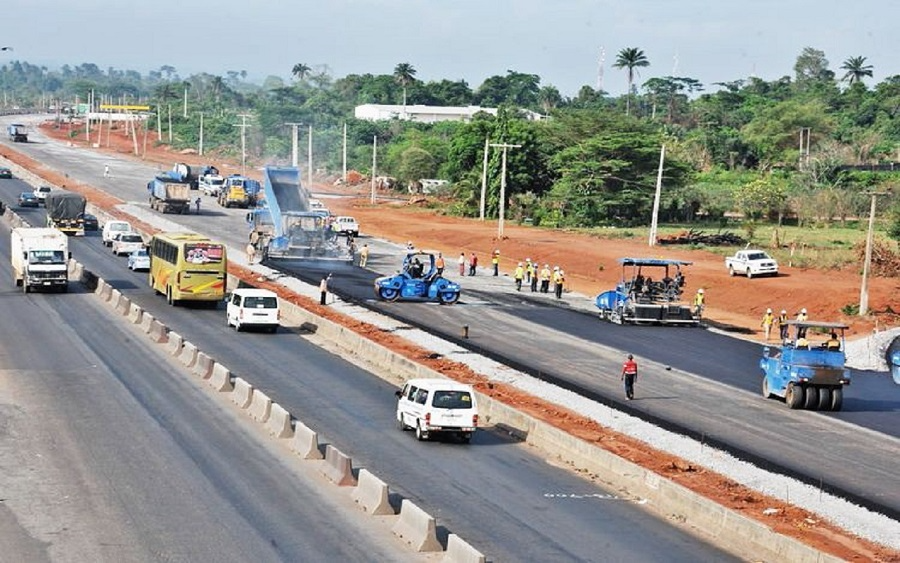
The Federal Government has earmarked a substantial N367.9 billion multilateral and bilateral loan in the proposed 2026 budget to advance the construction and dualisation of the Lafia Road and the 9th Mile–Otukpo–Makurdi corridor.
Okay News reports that the allocation, detailed in the 2026 Appropriation Bill, ranks among the largest under the Ministry of Works’ N3.49 trillion total budget for the fiscal year.
The project, coded ERGP12234171, forms part of ongoing efforts to improve connectivity across the North-Central and South-East regions through strategic highway development.
The Ministry of Works received N3.44 trillion for capital expenditure, with the majority directed toward continuing road construction, rehabilitation, and dualisation nationwide.
Other significant ongoing projects include the dualisation of the Kano–Katsina Road (Phase II) with N52.5 billion, Phase I of the same corridor at N23.8 billion, and multinational counterpart funding for the Lafia Bypass and related sections at N23.8 billion.
The Kano–Maiduguri Road (Section I: Kano–Wudil–Shuarin, 105 km) was allocated N13.3 billion, while the Ikorodu–Itoikin Road reconstruction in Lagos received N12.6 billion.
The Abuja–Lokoja Road (Zuba–Abaji section) got N7.7 billion, alongside the Ikot Ekpene border–Aba–Owerri dualisation at N7.7 billion and Numan–Jalingo rehabilitation at N7.0 billion.
The Damaturu–Maiduguri section of the Kano–Maiduguri Road also received N7.0 billion, while the Mubi–Maiduguri Road (Section 3) was allocated N7.01 billion.
A contingency fund (ERGP1247779) was provisioned N100 billion, with N600 billion earmarked for new projects across the six geopolitical zones (ERGP1247780), though specifics were not detailed.
The reliance on external financing reflects the government’s strategy to address Nigeria’s 35,000-kilometre federal road network challenges, given limitations of direct budgetary funding alone.
Minister of State for Works Muhammad Bello Goronyo previously noted that years of neglect, inflation, and security issues have widened the infrastructure deficit, necessitating alternative models.
Major projects increasingly depend on external loans, private-sector funding, or tolling mechanisms for sustainability.
The Benin–Asaba Superhighway is advancing through full private investment, while the Lagos–Calabar Coastal Highway secured $747 million in July 2025 and an additional $1.2 billion in December 2025.
These initiatives aim to enhance connectivity, reduce transport costs, and stimulate economic activity across regions.