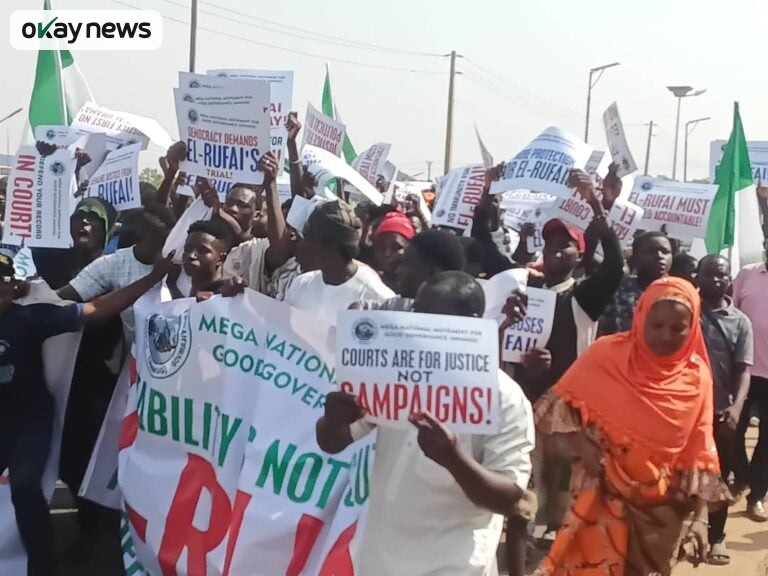
Hundreds of demonstrators gathered on Monday, February 16, 2026, at the headquarters of the Economic and Financial Crimes Commission (EFCC), Nigeria’s federal agency that investigates corruption and financial crimes, calling for swift action on allegations linked to Nasir El-Rufai, a former governor of Kaduna State in north-west Nigeria.
Okay News reports that the protest took place outside the EFCC’s main office in Abuja, Nigeria’s capital, where the group said it wanted a thorough investigation into an alleged ₦432 billion Nigerian naira (about $319 million) corruption case involving the former governor. The dollar estimate is based on the Central Bank of Nigeria’s official Nigerian Foreign Exchange Market rate of about ₦1,355 to $1, published for Friday, February 13, 2026.
The demonstrators said they were part of the Mega National Movement for Good Governance. They chanted and held placards with messages such as “Answer The Charges El-Rufai” and “El-Rufai Not Above The Law.” Witnesses at the scene said some protesters attempted to move into the EFCC premises, but security personnel stopped them at the entrance.
Speaking to journalists, the group’s spokesperson, Muhammad Abdullahi, said the allegations should be handled as a legal matter and not turned into partisan conflict. He said, “We reiterate its firm position that the ongoing prosecution of former Kaduna State Governor, Nasir El-Rufai, remains a lawful and constitutional matter strictly between him and the Government of Kaduna State. This issue should not be reduced to a mere political drama or emotional manipulation.
“It is a question of accountability and stewardship of public trust. The Kaduna State House of Assembly Ad-Hoc Committee Report (2024) raised serious concerns regarding financial management, public debt profile, and contract procedures under the previous administration.
“It is also a matter of public record that some former appointees and close allies—including Jafaru Sani, Jimmy Lawal, Bashir Saidu, and Samuel Aruwa—are already in custody or undergoing investigation in connection with these allegations.”
Abdullahi urged the EFCC and the Independent Corrupt Practices and Other Related Offences Commission (ICPC), another Nigerian anti-corruption agency, to pursue what he described as an evidence-based and transparent process. He referenced Section 15(5) of the Constitution of the Federal Republic of Nigeria, which states that the country’s institutions should abolish corrupt practices and abuse of power.
The protesters argued that the issue should be treated as prosecution under the law, not persecution. They said El-Rufai should allow the courts and investigators to do their work, noting that some officials who served under his administration were already facing investigation.
The EFCC’s spokesperson, Dele Oyewale, appealed for calm and said the agency would pass the group’s petition to leadership within the commission. He said, “The EFCC recognises the right of Nigerians to lawful protest in respect of any issue they feel so concerned about. Your protest and demands will be communicated to the executive chairman accordingly.
“I want to assure you that the EFCC, as we know i,t will do its job professionally by attending to all the issues that you raised in your letter. I also want to encourage you to continue to be peaceful in the exercise of your right because that is what democracy is all about.
“As far as the EFCC is concerned, the right thing will be done. Our processes and procedures will be followed, and Nigerians will see that we have actually acquainted ourselves very well with this issue. All your grievances will be communicated to the appropriate quarters.”
The protest came amid political tension around allegations of financial impropriety during El-Rufai’s eight-year tenure as governor of Kaduna State. The former governor is facing a ₦432 billion probe after all 28 members of the Kaduna State House of Assembly, the state’s legislature, unanimously backed a petition to both the EFCC and the ICPC.
The demonstration also followed public comments from Bayo Onanuga, Special Adviser to Nigeria’s President Bola Ahmed Tinubu on Information and Strategy. Onanuga accused El-Rufai of portraying himself as a victim to avoid accountability. In a post on Monday, February 16, 2026, on X, the social media platform formerly known as Twitter, Onanuga wrote: “One, to create political tension in the country, create an atmosphere of fear and unrest, and then damage the government through deliberate misinformation.
“Two, to divert attention from his domestic problems in Kaduna State, where he is facing massive corruption allegations,” he said.
Onanuga added, “To draw attention to himself and project himself as a victim of persecution, he wants to nationalise his personal problems with his home state government, knowing that Nigerians will not be on his side over corruption charges.”
Separately, Temitope Ajayi, Senior Special Assistant to President Tinubu on Media, had also accused El-Rufai of political manoeuvring in an effort to stay relevant.