

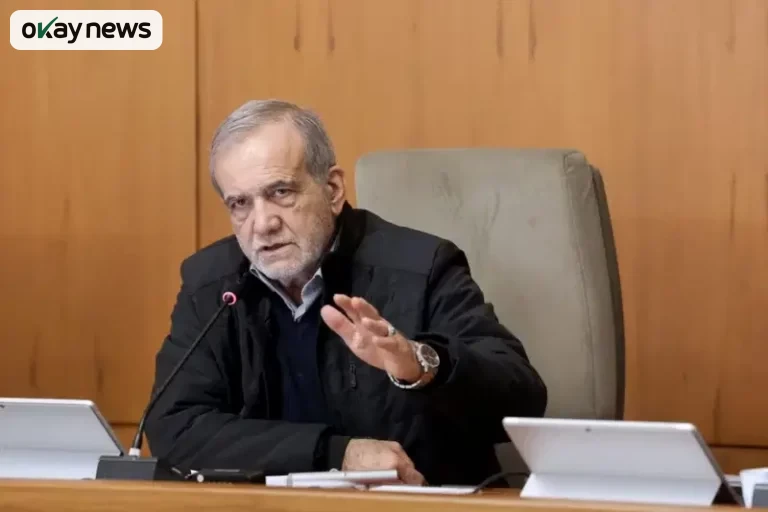
Geneva, Switzerland – President Masoud Pezeshkian of the Islamic Republic of Iran said on Wednesday, February 26, 2026, that his country is “not at all” seeking to develop a nuclear weapon, as fresh negotiations with the United States of America are set to begin in Switzerland on Thursday.
The talks come at a time of heightened tension in the Middle East. The United States government, led by President Donald Trump, has increased its military presence in the region to levels not seen in decades and has warned of possible military action if a new agreement is not reached.
Speaking ahead of the negotiations, President Pezeshkian referred to Iran’s Supreme Leader, Ayatollah Ali Khamenei, and said, “Our Supreme Leader has already stated that we will not have nuclear weapons at all.” His remarks were aimed at reassuring the international community that Iran’s nuclear activities are not intended for military use.
The discussions, which are being mediated by the government of Oman, follow earlier rounds of dialogue held in the Omani capital and in Geneva. The mediation effort is intended to reduce tensions between Tehran and Washington and to prevent a broader regional conflict.
Iran has consistently maintained that the negotiations should focus only on its nuclear programme, which it says is for civilian purposes such as energy production. However, the United States government has indicated that it also wants Iran to address its ballistic missile programme and its support for armed groups in the Middle East.
In his State of the Union address delivered on Tuesday in Washington, President Trump accused Iran of “pursuing sinister nuclear ambitions”. He also said Tehran had “already developed missiles that can threaten Europe and our bases overseas, and they’re working to build missiles that will soon reach the United States of America”.
Iran’s Ministry of Foreign Affairs rejected those claims, describing them as “big lies”. According to information publicly disclosed by Tehran, the maximum range of Iran’s missiles is 2,000 kilometres, or about 1,200 miles. The United States Congressional Research Service has estimated that the range could be as high as 3,000 kilometres, still far short of the distance required to reach the continental United States.
President Trump’s remarks were delivered in the same United States Congress chamber where former President George W. Bush made the case for the 2003 invasion of Iraq, a historical comparison that has drawn attention among observers.
Ahead of Thursday’s meeting, United States Secretary of State Marco Rubio said Iran must also negotiate over its missile programme, calling Tehran’s refusal to discuss ballistic weapons “a big, big problem”. He added that “the president wants diplomatic solutions”.
At the same time, United States Vice President JD Vance urged Iran to take President Trump’s warnings seriously, saying the United States leader had a “right” to use military action. “You can’t let the craziest and worst regime in the world have nuclear weapons,” Vance said during an interview on Fox News.
On Wednesday, February 19, 2026, President Trump had said Iran had 15 days to reach an agreement.
Iran’s Foreign Minister, Abbas Araghchi, who is leading Tehran’s delegation, described the talks as “a historic opportunity” and said a deal was “within reach”. In a statement issued after meeting his Omani counterpart, Araghchi said the success of the negotiations depends “on the seriousness of the other side and its avoidance of contradictory behaviour and positions”.
The United States delegation is expected to include envoy Steve Witkoff and Jared Kushner, who is married to President Trump’s daughter, Ivanka.
Previous attempts to secure an agreement have faltered. An earlier effort collapsed last June when Israel launched surprise strikes on Iranian targets, triggering a 12-day conflict that the United States briefly joined with air strikes on Iranian nuclear facilities.
The diplomatic push also comes against the backdrop of internal unrest in Iran. In January 2026, Iranian authorities launched a wide-ranging crackdown on nationwide protests that had posed one of the most serious challenges to the Islamic Republic in recent years. Human rights groups say thousands of demonstrators were killed during earlier waves of protests.
Okay News reports that regional analysts believe the coming days will be critical in determining whether diplomacy can prevent further escalation. Emile Hokayem, a senior fellow for Middle East security at the International Institute for Strategic Studies, said “the region seems to expect a war”.
“There’s a lot of apprehension at this point, because the expectation is that this time” a war would be “bigger” than the one in June, he said.
Residents of Tehran, Iran’s capital, expressed mixed feelings in interviews. A 60-year-old homemaker identified as Tayebeh said President Trump had “said that war would be very bad for Iran”.
“There would be famine and people would suffer a lot. People are suffering now, but at least with war, our fate might be clear,” she said.
The outcome of the Switzerland talks could shape not only relations between Iran and the United States, but also the broader security environment across the Middle East and beyond.