Nigeria’s solid minerals sector recorded a sharp rise in government revenue in 2025, with earnings climbing to over ₦70 billion, reflecting the impact of sweeping reforms introduced by the Federal Government.
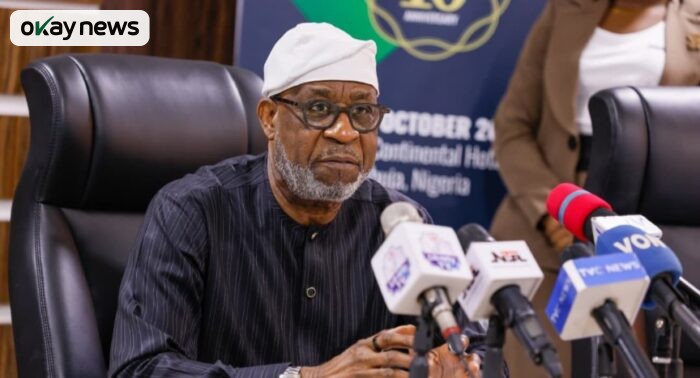
The increase, disclosed by Segun Tomori, Special Assistant on Media to the Minister of Solid Minerals Development, Dr. Dele Alake, represents a significant jump from ₦16 billion in 2023, underscoring renewed momentum in the mining industry.
Okay News reports that revenue from the sector rose to ₦38 billion in 2024 before accelerating further in 2025, a trend attributed to policy changes aimed at transparency, enforcement, and investor confidence.
Tomori said the gains followed the implementation of Alake’s seven-point agenda, which prioritises sector reforms, stronger regulation, local value addition, and improved governance across mining operations nationwide.
As part of the clean-up, the ministry revoked 1,633 mining licences in late 2023 due to non-payment of service fees, followed by the withdrawal of 924 dormant licences in early 2024 to free up assets for credible investors.
Guidelines governing Community Development Agreements (CDAs) were also revised to ensure that host communities formally consent before mining licences are approved, a move aimed at reducing conflict and strengthening social licence to operate.
Illegal mining, long identified as a major drag on sector revenues, was tackled through the establishment of mining marshals in 2024, leading to the arrest of over 300 illegal miners, ongoing prosecution of about 150 suspects, and the recovery of 98 illegal mining sites.
Authorities said enforcement will be further strengthened in 2026 with the rollout of nationwide satellite surveillance to monitor mining activities and deter illegal operations.
At the continental level, Nigeria’s push for local value addition contributed to the creation of the Africa Minerals Strategy Group, which elected Alake as its pioneer chairman, reinforcing Nigeria’s leadership role in Africa’s mining reform agenda.
The ministry also adopted a cooperative federalism model to address tensions between federal and state governments, encouraging states to apply for mining licences and operate through limited liability companies, resulting in joint ventures in Nasarawa, Kaduna, Oyo, and the Federal Capital Territory.
Tomori disclosed that lithium processing plants are emerging nationwide, a $400 million rare-earth metals facility is in development, and about $1.5 billion in foreign direct investment has been attracted to the sector since 2023.
While describing the revenue growth as unprecedented, officials said it remains only a fraction of the sector’s potential, with plans to consolidate reforms in 2026 to position solid minerals as a major contributor to Nigeria’s Gross Domestic Product.