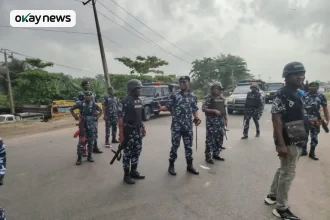
ABUJA, Nigeria – The Nigeria Police Force has stepped up security measures across the country following rising hostilities in the Middle East, directing officers nationwide to increase surveillance around worship centres and other public spaces.
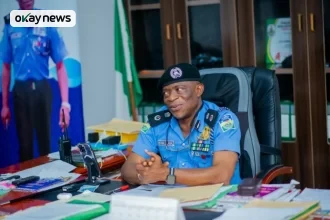
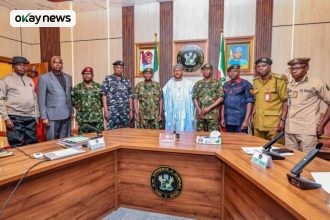
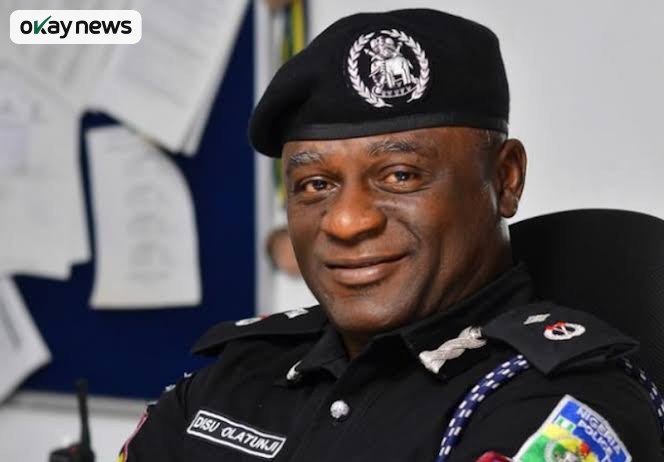
In a statement issued on Sunday, March 1, 2026, the Force Public Relations Officer, Assistant Commissioner of Police Benjamin Hundeyin, said the Acting Inspector-General of Police, Olatunji Disu, had ordered all Commissioners of Police in Nigeria’s 36 states and the Federal Capital Territory, which includes the capital city Abuja, to intensify intelligence gathering and visible patrols.
The directive places particular focus on the North West, North East, and North Central geopolitical zones of Nigeria, regions that have previously faced security challenges. Commissioners have also been instructed to work closely with traditional rulers and religious leaders to prevent any attempt to exploit global tensions to trigger unrest within Nigeria.
“The Ag. IGP has directed all Commissioners of Police in the 36 States and the Federal Capital Territory, with particular attention to the North West, North East, and North Central zones, to heighten surveillance and intelligence gathering, strengthen collaboration with traditional and religious leaders, enhance visibility policing around worship centres and public spaces, and swiftly address any attempt by individuals or groups to exploit global developments to incite unrest or sectarian tension.
“The Nigeria Police Force reiterates that Nigeria will not serve as a theatre for foreign conflicts. Any attempt to import external ideological or religious tensions into the country will be met with the full weight of the law.
“IGP Disu calls on community leaders nationwide to continue promoting peace and urges citizens to remain calm, vigilant, and law-abiding, reporting any suspicious activity to the nearest police formation.”
The police reassurance comes as tensions in the Middle East sharply escalated following joint military strikes by the United States and Israel on Iran late Saturday, February 28, 2026. The strikes reportedly resulted in the death of Ayatollah Ali Khamenei, Iran’s Supreme Leader, along with other senior officials.
Iran subsequently launched large-scale counterattacks beginning Saturday, with explosions reported in parts of the United Arab Emirates, Qatar, and Bahrain, countries that host United States military bases. Reports from the region indicate civilian casualties, flight cancellations, airport closures, and damage to infrastructure in densely populated areas.
Although Nigeria is geographically distant from the Middle East conflict, security agencies are concerned about the potential for global events to inflame local tensions in a religiously and ethnically diverse country of more than 200 million people.
On Saturday, February 28, 2026, the federal government of Nigeria issued travel advisories urging Nigerian citizens in Iran and Gulf countries to exercise maximum caution. The Ministry of Foreign Affairs separately called for restraint and de-escalation by all parties involved in the conflict.
Okay News reports that Nigerian authorities are seeking to reassure the public that the country remains stable, while also signaling readiness to respond swiftly to any security threats linked to international developments.
The police said they remain fully prepared to safeguard lives and property and to maintain national security at all times.