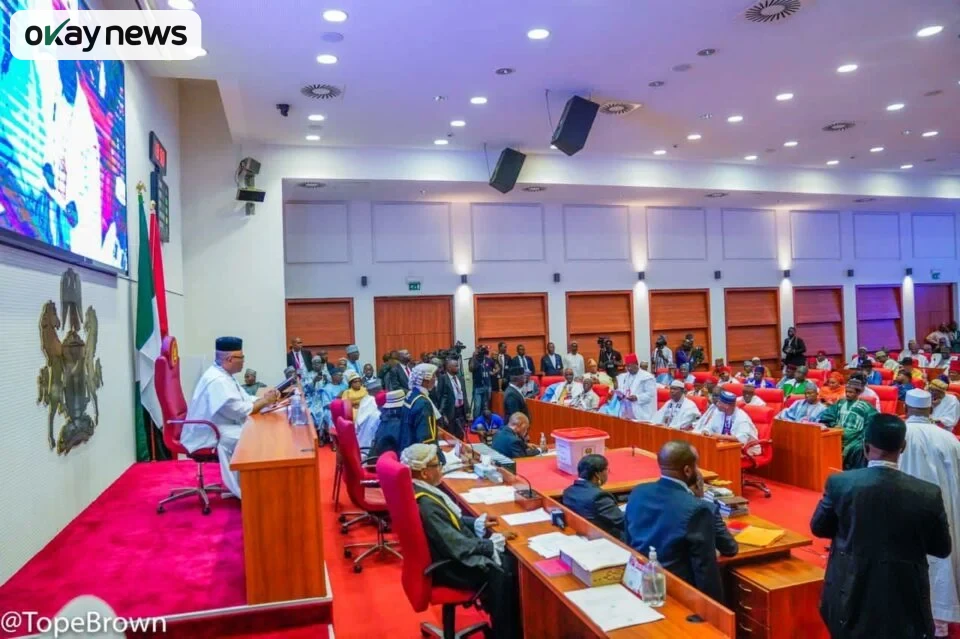
The Senate of the Federal Republic of Nigeria, the upper chamber of Nigeria’s National Assembly, on Tuesday, February 17, 2026, passed the Electoral Act, 2022 (Repeal and Re-Enactment) Bill 2026 after hours of tense debate over the electronic transmission of election results.
The legislation seeks to amend Nigeria’s main election law ahead of the country’s next general elections scheduled for 2027. The most contentious issue during deliberations was Clause 60, which addresses how election results are transmitted from polling units.
Proceedings became heated when Senator Enyinnaya Abaribe, who represents Abia South Senatorial District in Abia State, southern Nigeria, under the platform of the All Progressives Grand Alliance, demanded a formal division of the chamber on Clause 60. A division is a voting process in which lawmakers physically indicate their position for or against a proposal.
Senate President Godswill Akpabio, a former governor of Akwa Ibom State in southern Nigeria and the presiding officer of the Senate, said he believed the request for division had earlier been withdrawn. Opposition senators immediately objected, leading to a noisy exchange on the Senate floor.
Deputy Senate President Barau Jibrin cited Order 52(6) of the Senate Standing Orders, arguing that it would be procedurally improper to revisit a matter already ruled on by the Senate President. His intervention triggered further uproar, and at one point Senator Sunday Karimi was seen briefly confronting Abaribe before calm was restored.
Senate Leader Opeyemi Bamidele explained that he had sponsored a motion for rescission, a parliamentary procedure that allows lawmakers to reverse a previous decision. He said earlier resolutions of the Senate were no longer valid and maintained that Abaribe’s request was consistent with the rescission motion.
Akpabio suggested that the call for division was an attempt by Abaribe to publicly demonstrate his position to Nigerians. He upheld the point of order raised on the floor, after which Abaribe formally moved his motion.
Invoking Order 72(1) of the Senate rules, Abaribe called for a division on Clause 60(3), particularly the provision stating that if electronic transmission of results fails, Form EC8A should not be used as the sole basis for determining results. He proposed deleting the clause that permits manual transmission of results in the event of network failure.
When the vote was taken, 55 senators supported retaining the proviso that allows manual backup transmission, while 15 senators opposed it. The proposal to remove the manual transmission option therefore failed.
Okay News reports that the debate over electronic transmission reflects broader concerns in Nigeria about election credibility, transparency, and the reliability of telecommunications infrastructure across the country’s 36 states and the Federal Capital Territory.
Earlier in the session, the Senate had temporarily suspended proceedings to reconsider the bill clause by clause after a motion to rescind its earlier passage was introduced and seconded. This allowed the chamber to dissolve into the Committee of the Whole, a format in which all senators sit as a committee to examine legislation in detail.
Before rescinding the bill, several lawmakers raised concerns about the timing of Nigeria’s 2027 general elections and technical inconsistencies within the proposed law.
Senate Leader Bamidele told colleagues that the motion followed an announcement by the Independent National Electoral Commission, Nigeria’s constitutionally established election management body known as INEC, fixing the 2027 general elections for February 2027 after consultations with the leadership of the National Assembly.
According to Bamidele, stakeholders had expressed concern that the proposed election date might conflict with Clause 28 of the law, which requires elections to be held at least 360 days before the expiration of current office holders’ tenure. He also noted that holding elections during the Islamic holy month of Ramadan could affect voter turnout, logistics, stakeholder participation, and the overall inclusiveness and credibility of the process in a country with a large Muslim population.
Lawmakers further identified discrepancies in the bill’s Long Title and in several clauses, including Clauses 6, 9, 10, 22, 23, 28, 29, 32, 42, 47, 51, 60, 62, 64, 65, 73, 77, 86, 87, 89, 93, and 143. These inconsistencies were said to affect cross referencing, serial numbering, and internal coherence within the legislation.
With the final vote, the Senate cleared the amended Electoral Act Bill, setting the stage for further legislative steps before it can become law. The developments are significant as Nigeria prepares for its next nationwide elections, which will determine the country’s president, governors, federal and state lawmakers.