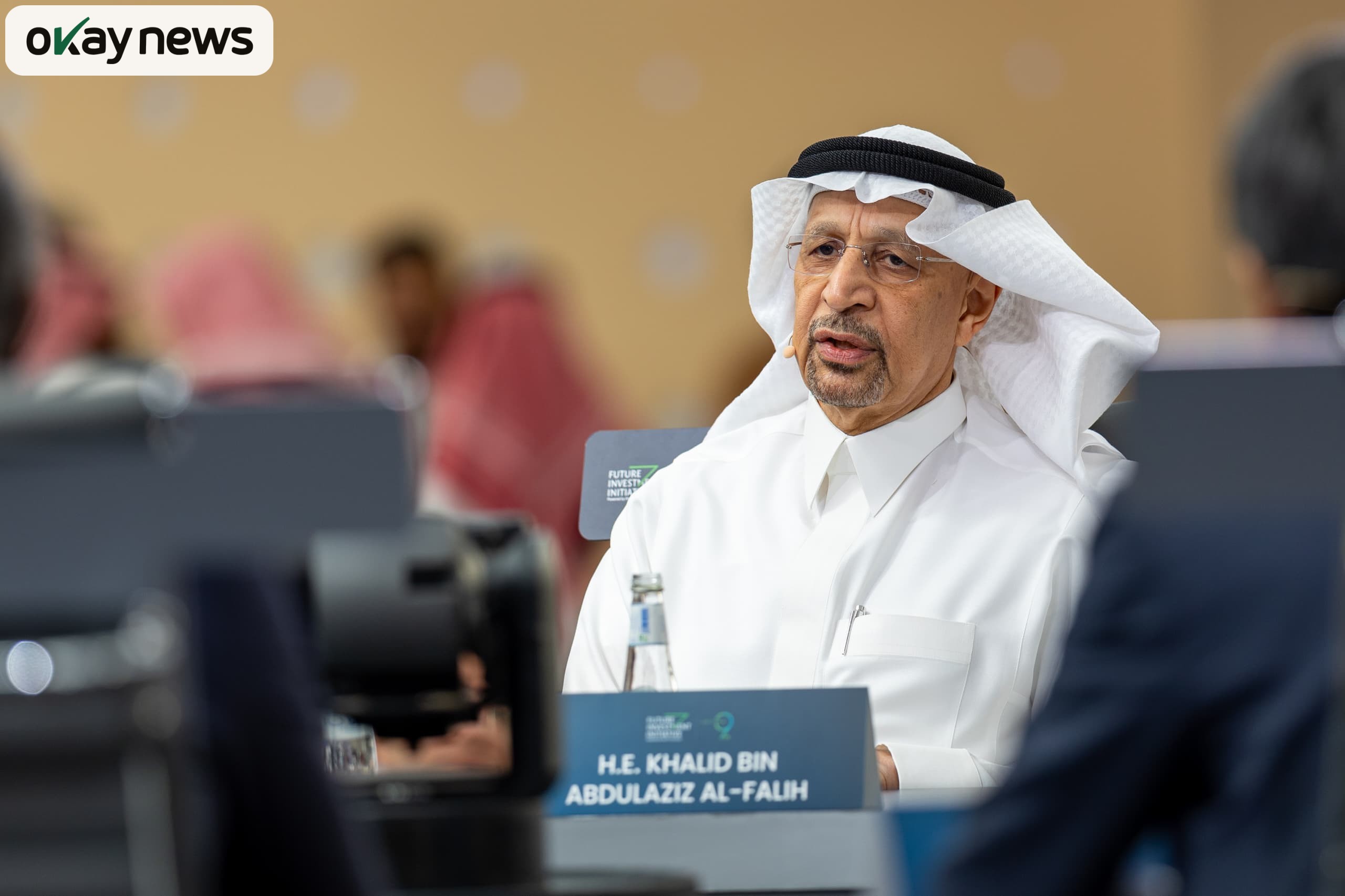
Saudi Arabia’s Minister of Investment, H.E. Khalid Bin Abdulaziz Al Falih, has highlighted the kingdom’s rapid economic transformation, noting that the country’s growth is now being powered by its non-oil sectors rather than oil revenues.
Speaking at the Future Investment Initiative (FII9) forum under the theme “How To Keep This Fragmenting World From Fragmenting,” Al Falih said Saudi Arabia’s gross domestic product (GDP) has doubled in recent years, defying the long-held notion that the kingdom’s economy rises and falls with oil prices.
“Our GDP has doubled. Everybody thought that Saudi Arabia rises and falls with oil prices, but our doubled GDP is driven by the non-oil economy,” he stated.
According to him, the kingdom’s transformation is being propelled by emerging industries such as advanced manufacturing and technology. “Foreign Direct Investment (FDI) has grown significantly. About $1 billion has been deployed in our startups, and we account for nearly 60 percent of the Middle East market,” Al Falih explained.
Okay News reports that the minister also noted that Saudi Arabia’s diversification efforts are yielding measurable results across various sectors.
He revealed that 40 percent of Saudi Arabia’s expenditure is now funded by non-oil revenue. “Our employment has been halved, and women’s participation in the workforce has doubled,” he said, describing the nation’s competitive edge as “multifaceted.”
The minister emphasized that despite global uncertainties, the kingdom’s direction remains clear and stable. “People can predict where the kingdom is going to be in 2030. Political tensions don’t change where we are going. Non-oil growth is between 4 and 5 percent. There is certainty in Saudi Arabia,” Al Falih affirmed.
During the session, CNN anchor Becky Anderson asked him about Saudi Arabia’s focus for 2025 and the next five years of its Vision 2030 roadmap. Responding, Al Falih said the kingdom’s vision extends beyond short-term goals.
“The vision is not specific to 2025. In the last couple of years, we have seen huge opportunities emerging, and the most obvious is Artificial Intelligence (AI),” he explained.
He added that the government is channeling resources into sectors that align with Saudi Arabia’s strengths and called for stronger private sector participation. “This is the time for the private sector to come in. We know who the partners we can trust are,” he said.
Al Falih concluded by emphasizing Saudi Arabia’s global connectivity and strong economic partnerships. “One of our strengths is that we are connected globally, with deep-rooted relationships. The U.S. remains the biggest investor in the kingdom,” he noted.