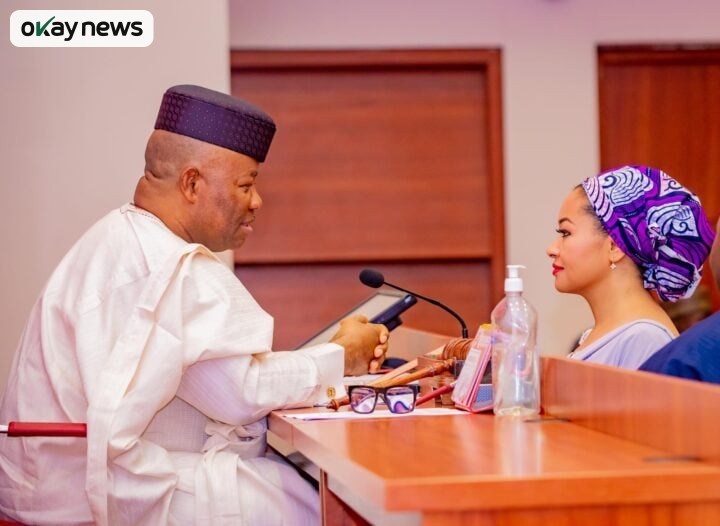
The courtroom fight over the suspension of Natasha Akpoti-Uduaghan, the senator representing Kogi Central Senatorial District in Kogi State, North-Central Nigeria, has moved to a new stage after Nigeria’s Senate President, Godswill Akpabio, filed fresh processes at the Supreme Court of Nigeria, the country’s highest court.
Okay News reports that court documents sighted on Thursday, 22 January 2026, show Akpabio is asking the apex court to regularise and keep alive his appeal, following earlier decisions by lower courts connected to the dispute.
The documents, which carry the references SC NO: SC/CV/1111/2025, Appeal No: CA/ABJ/CV/1107/2025 and Suit No: FHC/ABJ/CS/384/2025, partly read, “Motion on Notice brought pursuant to Order 4 Rules 6 & 16 of the Supreme Court 2024 Sections 22, 27 (1) 4, 2 & 4 and 29 of the Supreme Court ACT CAP S.15 Laws of the Federal Law Section 233 (1) and 3 of the Constitution of the Federal Republic of Nigeria 1999 (As Amended) and under the inherent jurisdiction of this Honourable Court.”
In the filing, Akpabio is listed as the appellant. The respondents are Akpoti-Uduaghan, the Clerk of the National Assembly of the Federal Republic of Nigeria (National Assembly), the Senate of the Federal Republic of Nigeria (Senate), and the Chairman of the Senate Committee on Ethics, Privileges and Public Petitions, Senator Neda Imasuen.
The disagreement began during a plenary session in February 2025, when Akpoti-Uduaghan raised a matter of privilege and accused the leadership of procedural breaches. The Senate referred the complaint to its Committee on Ethics, Privileges and Public Petitions, which later recommended disciplinary action that resulted in her suspension.
Akpoti-Uduaghan challenged the decision at the Federal High Court in Abuja, Nigeria’s capital city, arguing that she was denied a fair hearing and that the Senate did not comply with its own Standing Orders.
In a judgment delivered on Friday, 4 July 2025, the Federal High Court faulted the suspension, describing it as excessive and unconstitutional. The dispute then moved through proceedings at the Court of Appeal of Nigeria, before Akpabio decided to take the matter to the Supreme Court.
In his latest move, the former governor is asking the Supreme Court for an extension of time to apply for leave to appeal, leave to appeal on grounds of mixed law and fact, and an order deeming his notice of appeal and brief of argument as properly filed. His argument is that the Senate acted within its constitutional authority, pointing to Section 60 of the Constitution of the Federal Republic of Nigeria 1999 (as amended), which empowers Nigeria’s National Assembly to regulate its internal procedures.
Akpabio also contended that the Senate President was not under an obligation to immediately rule on every point of privilege and that the Senate lawfully activated its disciplinary process.
Akpoti-Uduaghan, however, has continued to insist that her suspension was unlawful and carried out without a fair hearing, maintaining that the Senate failed to follow its own rules. It was confirmed on Thursday, 22 January 2026, that her lawyers had been served with the Supreme Court processes.
The wider dispute also includes a related contempt issue tied to a social media post made by Akpoti-Uduaghan while the suit was still pending. A Federal High Court had fined her and ordered a public apology, and she has also appealed that decision.
Legal observers say the Supreme Court’s eventual decision could help define how far legislative discipline can go in a constitutional democracy, and when courts should step in to review the internal actions of a parliament. The case is being watched closely because it sits at the intersection of parliamentary privilege, due process, and judicial oversight.
The development comes barely two weeks after Akpabio announced that he had decided to withdraw pending court cases against his adversaries.
Akpoti-Uduaghan returned to duties on Tuesday, 23 September 2025, after completing a six-month suspension and regaining access to her office at the National Assembly. Her office had been sealed since Thursday, 6 March 2025, following her suspension over alleged misconduct during a protest linked to the reassignment of her seat by Akpabio on Thursday, 20 February 2025.
Although the suspension ended in September 2025, she did not return immediately, amid continued legal disputes and reported resistance from Senate leadership. Following the Friday, 4 July 2025, judgment, she formally notified the Senate of her intention to resume, but her request was initially rejected.