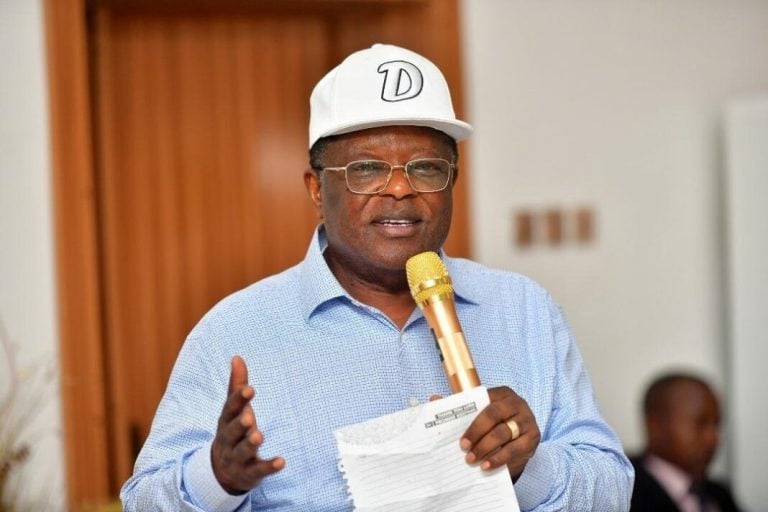
Minister of Works, David Umahi, has called on political leaders and citizens from Nigeria’s South-East region to remain patient and committed to the principle of fairness in their quest to produce the nation’s president, stressing that it is not yet the region’s turn to occupy the country’s top political seat.
Speaking in Abuja during an interview with the News Agency of Nigeria, Umahi explained that the 2027 presidential election should not be a contest for the South-East, insisting that President Bola Ahmed Tinubu must be allowed to complete his constitutionally guaranteed two terms before any power shift is considered.
According to him, the ongoing administration represents a continuation of the southern political agreement reached by leaders before the 2023 general elections. He recalled that before the last presidential race, 17 southern governors unanimously agreed in Asaba, Delta State, that power should rotate from the North to the South, regardless of party affiliation.
“No, it is not our time; it is not the time of South-East yet,” Umahi said. “We, the 17 Southern governors, went to Asaba before 2023, and we went to say, listen, it doesn’t matter the political party, but the next president should come from the South. All of us tried, but the crown came upon President Bola Tinubu. He is from the South, and so, it is wrong for the South-East to come and say, oh, it is their turn.”
The minister noted that President Tinubu’s presidency represents the collective interest of both northern and southern blocs. “He has to finish the eight years. The eight years he took are for all of us, both the South and the North,” Umahi said. “So, he has to finish, and when he has finished in 2031, the South-East can now vie, in the sense that they have never tasted the position before.”
He added that the North-East would also be eligible to contest for the presidency at that time, stressing that equity and fairness must guide political succession in Nigeria.
“I believe strongly that it is when equity and fairness have been established that rotation will become a thing of joy,” he noted. “So for me, it is not the time of the South-East. And when the time comes, we have sons and daughters that are eminently qualified to contest for president.”
Okay News reports that Umahi also admitted that the South-East had experienced political and infrastructural marginalisation in previous administrations, making it difficult for leaders in the region to mobilise support for the All Progressives Congress (APC) during the 2023 general elections.
Despite this, he maintained that President Tinubu has shown fairness in governance, saying, “Right now, President Bola Tinubu does not want to know where you come from. He is treating everybody very nicely.”
While acknowledging that some individuals from the South-East may feel underrepresented in terms of federal appointments, Umahi argued that his role as Minister of Works is a major position that has brought significant benefits to the region through infrastructure development. He cited major ongoing projects in the South-East worth hundreds of billions of naira, such as the Enugu-Onitsha expressway, Aba-Port Harcourt road, and other federal highways under construction.
According to the minister, these projects reflect the current administration’s commitment to equitable development, proving that the President values inclusiveness over sectional politics.
He urged South-Easterners to acknowledge the progress being made and remain patient for their turn in the spirit of national unity. “We should be clapping with our hands and legs for President Bola Tinubu,” Umahi said. “My appointment as Minister of Works is not just an appointment; it is what you have used it to do for the entire country.”
Umahi concluded that when the South-East’s time comes, it would be backed by equity, fairness, and national consensus — the same principles that brought power to the South in 2023.