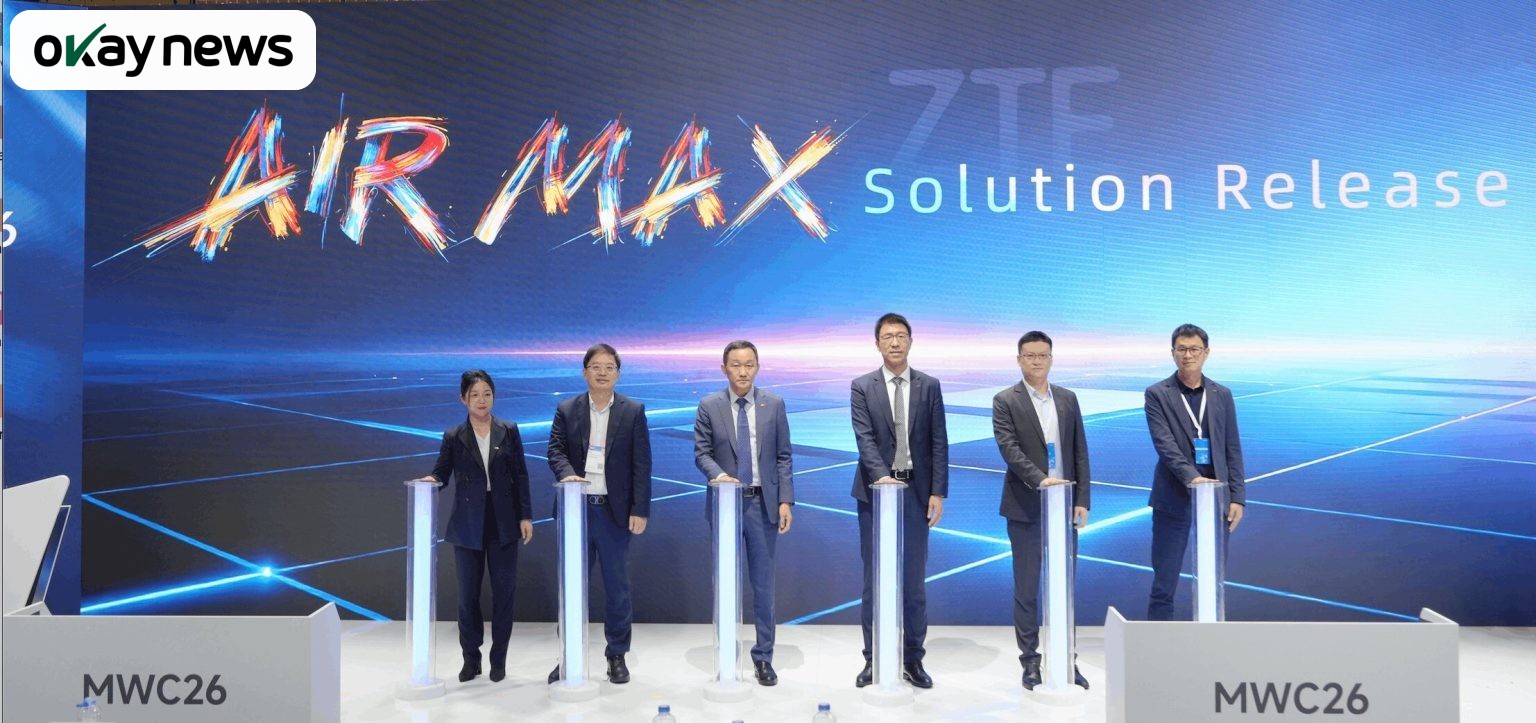
BARCELONA, Spain — ZTE Corporation has introduced its new AIR MAX mobile network solution at MWC Barcelona 2026, positioning the platform as a next-generation infrastructure designed to support the rapid rise of artificial intelligence in telecommunications.
The solution, unveiled during the company’s presentation at the annual technology gathering in Barcelona, Spain, focuses on improving energy efficiency, workforce productivity, and investment efficiency for telecom operators navigating the transition into the AI-driven digital economy.
Okay News reports that the launch reflects growing demand from telecommunications providers for infrastructure capable of supporting advanced AI workloads, automation, and increasingly complex data traffic.
Delivering the opening keynote at the event, Zhang Wanchun, Senior Vice President of ZTE, said the global technology landscape has changed dramatically since the rise of generative AI.
“Since the launch of ChatGPT at the end of 2022, the global technological landscape has undergone a fundamental transformation. Computing costs have continued to decline, the level of intelligence has risen at an accelerated pace, and intelligent agents and AI terminals have emerged one after another. The rapidly popularized AI is profoundly reshaping the economy and society. For the mobile communication industry, we are accelerating the leap from the ‘data era’ to a brand-new era of ‘Bit+Token’. ZTE will actively drive the transformation of mobile networks and embrace new historical opportunities hand in hand with industrial partners.”
According to ZTE, the AIR MAX system builds on the company’s earlier AIR network architecture introduced in 2025 but shifts focus from pure network performance to business value creation for telecom operators.
Explaining the concept behind the platform, Tang Xue, Vice President of ZTE and General Manager of Strategy and Architecture for Wireless and Computing Products, said the solution is designed to support the explosive growth of AI-driven services.
“Facing the AI era featured by the explosive growth of new businesses, AIR MAX is exactly the optimal mobile network solution we offer to the industry,” Tang said. “In 2025, we launched the AIR solution; today, we shift our focus from network performance to business value. Relying on the core philosophy of ‘serving AI with AI’, AIR MAX drives systematic capability upgrades targeting maximized energy efficiency, workforce efficiency, and investment efficiency, establishing a new paradigm for mobile networks in the AI era.”
The platform introduces a three-layer architecture designed to transform mobile networks into AI-enabled digital engines rather than traditional data pipelines.
At the foundation is an AI-native infrastructure layer, which integrates artificial intelligence directly into network equipment. ZTE said the system can reduce energy consumption in wireless devices by 35 to 40 percent, while improving spectral efficiency by around 20 percent through AI-based signal optimisation technologies.
The infrastructure also uses a heterogeneous computing architecture combining specialised AI chips and processing units to support both communications and AI workloads. ZTE’s AIR Engine technology, which powers this system, has already been deployed at more than 150,000 network sites worldwide.
Additional innovations include AI-driven GigaMIMO technology, capable of delivering data throughput of up to 192 gigabits per second, alongside integrated sensing and communication tools that can detect drones with over 95 percent accuracy.
The second layer focuses on L4 autonomous intelligent operations, allowing telecom networks to manage and optimise themselves with minimal human intervention. ZTE said the system uses a hybrid model combining large general AI models with specialised smaller models, achieving 92 percent accuracy in autonomous decision-making and 95 percent factual consistency in operational outputs.
Industry observers say solutions like AIR MAX could play a key role in helping telecom operators manage the rising cost of network expansion while preparing for AI-driven services such as smart cities, autonomous systems, and next-generation connectivity platforms.
ZTE said the solution is designed to help operators transform traditional network infrastructure into intelligent platforms capable of generating new revenue streams while reducing operational costs in the emerging “Bit+Token” digital economy.