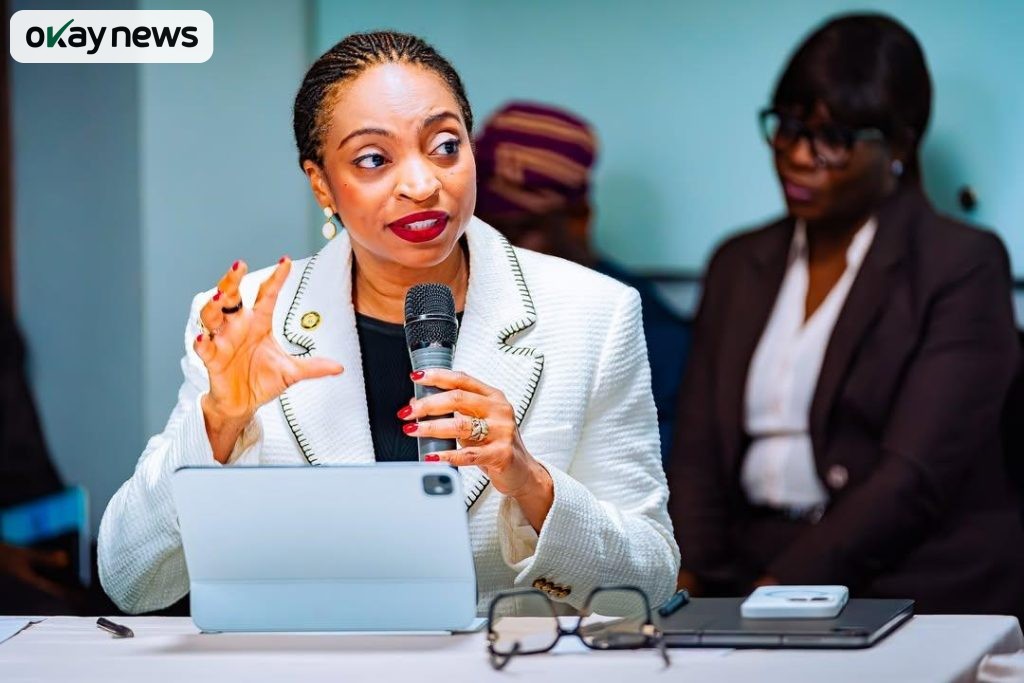
Abuja, Nigeria – Nigeria’s Minister of Industry, Trade and Investment, Jumoke Oduwole, has warned that the Federal Ministry’s proposed ₦2.72 billion capital allocation for 2026 is insufficient to deliver programmes aimed at industrialisation, trade expansion, and investment attraction.
Oduwole made the remarks on Monday while defending the ministry’s 2026 budget proposal before a joint sitting of the Senate Committees on Trade and Investment and Industry at the National Assembly in Abuja.
Okay News reports that the minister appealed to lawmakers for a targeted increase in capital funding, saying inadequate resources would limit the ministry’s ability to support President Bola Tinubu’s Renewed Hope Agenda and Nigeria’s ambition of building a one trillion dollar economy.
“The proposed capital allocation of ₦2.72 billion will be a stretch in meeting the full demands of our programmes and capital projects. Given the scope of our responsibilities, we respectfully seek the committee’s support for targeted enhancement of our capital allocation to enable us to effectively deliver on our mandate,” Oduwole told the lawmakers.
She described the Ministry of Industry, Trade and Investment as central to Nigeria’s economic transformation, particularly in diversifying the economy away from oil, expanding non-oil exports, stimulating domestic production, and attracting both local and foreign investment.
Chairman of the Senate Committee on Trade and Investment, Umar Sadiq, acknowledged the ministry’s strategic role in the administration’s economic vision.
“We are all aware of the Renewed Hope Agenda of Mr President, which is essentially to ensure that Nigeria achieves a one trillion dollar economy. The Ministry of Industry, Trade and Investment is a major partner in achieving this objective outside the oil sector,” Sadiq said.
However, he stressed that legislative support would depend on transparency, accountability, and measurable impact, adding that lawmakers were focused on outcomes rather than rhetoric.
Also speaking, Chairman of the Senate Committee on Industry, Francis Fadahunsi, urged the ministry to clearly demonstrate how the activities of its agencies translated into job creation, export growth, and industrial development.
In her presentation, Oduwole highlighted the ministry’s performance over the past two years as justification for increased capital funding. She said Nigeria recorded about $21 billion in capital importation in the first ten months of 2025, compared with $12 billion in 2024 and less than $4 billion in 2023.
She attributed the improvement to ministry-led interventions, including the development of more than $5 billion in bankable investment projects, sector-specific deal rooms, and Nigeria’s first Domestic Investor Summit.
According to the minister, the ministry also resolved more than 50 major investor bottlenecks and conducted over 100 bilateral investment engagements with countries including the United Kingdom, the United States, the United Arab Emirates, Brazil, and Japan. She said sustained engagement under the Nigeria–United Kingdom Economic and Trade Partnership resulted in United Kingdom investors accounting for about 65 percent of Nigeria’s foreign capital inflows in 2025.
On trade performance, Oduwole said Nigeria recorded a trade surplus in 2025, with total trade value estimated at ₦113 trillion in the first three quarters of the year. She added that exports grew by 11 percent year on year to approximately $6.1 billion, the highest level recorded in the country’s history.
She credited export facilitation measures, expansion of export warehouses, new air cargo corridors within Africa, and improved implementation of the African Continental Free Trade Area for a 14 percent increase in Nigeria’s intra-African trade.
In the industrial sector, Oduwole said Special Economic Zones generated more than $500 million in export revenue and created over 20,000 direct jobs in 2025. She also cited the Federal Executive Council’s approval of the National Industrial Policy and Nigeria’s successful bids to host CANEX 2026 and the Intra-Africa Trade Fair 2027.
Despite these achievements, the minister warned that funding constraints were already limiting the ministry’s effectiveness. She disclosed that while personnel and overhead allocations were fully utilised in 2024 and 2025, capital releases had been inconsistent, noting that no capital funds had been released to the ministry in 2025 as of the time of the budget defence.
Lawmakers expressed concern that the 2026 proposal largely rolled over the 2025 budget in line with federal guidelines, leaving limited space for new capital initiatives.
Responding, Oduwole acknowledged the rollover framework but insisted that enhanced capital funding remained critical even within those limits.
“Our ministry is programme-led and service-oriented. We are not a revenue-generating ministry in the conventional sense. We facilitate investment, resolve regulatory bottlenecks, open markets for Nigerian products, and support domestic investors. To do this effectively, we need capital resources,” she said.
She added that the ministry planned to intensify non-oil export promotion, deepen implementation of the African Continental Free Trade Area, deploy digital investor and trade facilitation platforms, and extend trade and investment support to sub-national governments across Nigeria’s geopolitical zones in 2026.
Members of the Senate committees said the concerns raised would be considered as lawmakers continue scrutiny of the 2026 budget proposals, amid pressure to ensure that key economic ministries are adequately funded to support growth, job creation, and economic diversification.