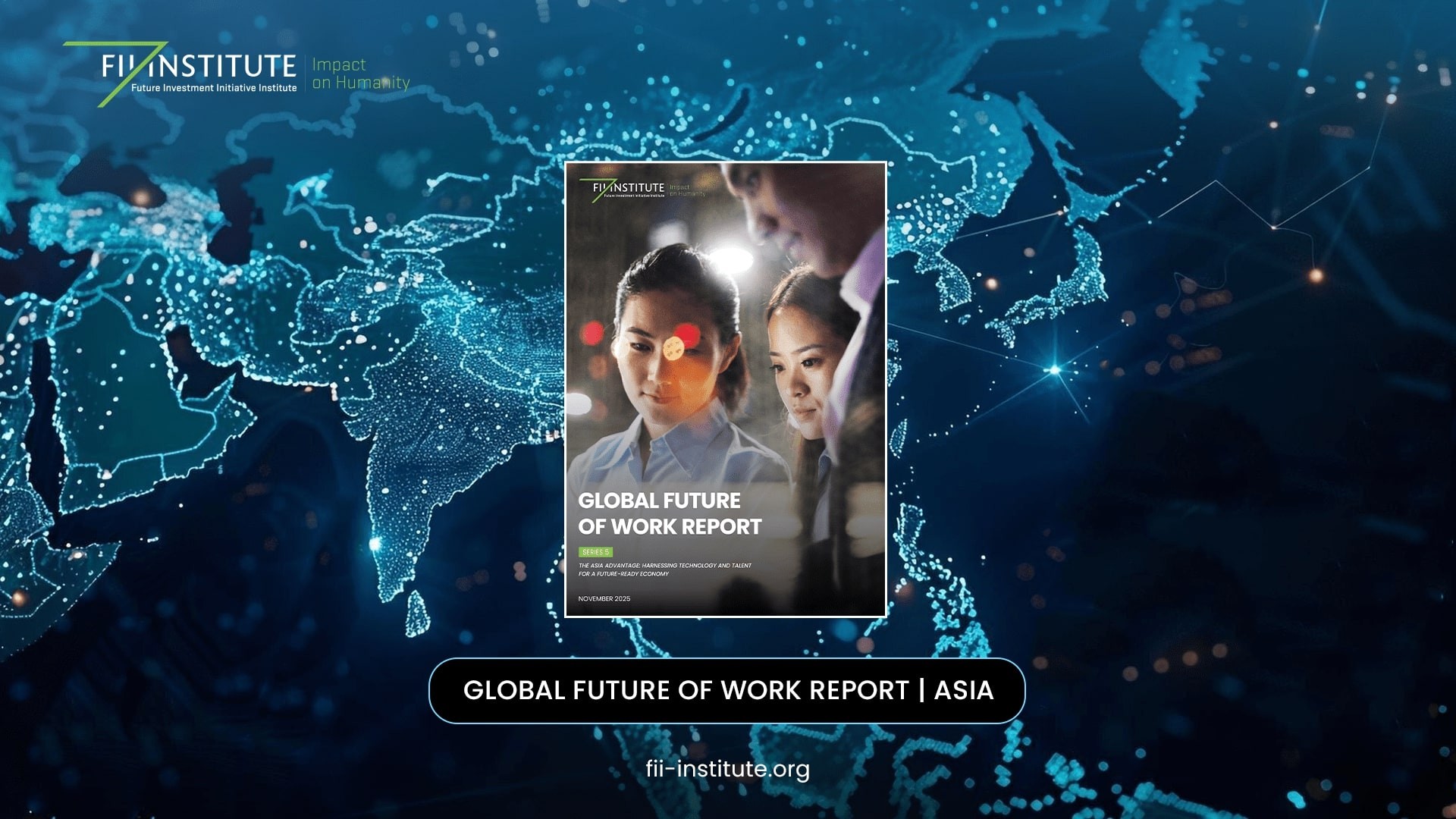
The Future Investment Initiative (FII) Institute has launched the fifth edition of its Global Future of Work Compass, unveiling new insights into how artificial intelligence, automation and youth skills are reshaping labour markets across Asia. The report was released on Saturday during the FII Priority Asia 2025 Summit in Tokyo.
The Asia-focused edition draws on extensive surveys of 200 companies and 100 young people in each of nine countries: China, India, Indonesia, Japan, Pakistan, the Philippines, South Korea, Thailand and Vietnam. The findings provide one of the most comprehensive portraits to date of how employers and young workers are preparing for disruptive technological change.
Alongside the report, the FII Institute introduced the Global Future of Work Navigator, a new digital platform designed to consolidate insights from all regional studies. The online tool allows policymakers, educators and investors to compare trends across continents and better understand where job markets, skills demand and technology adoption are heading.
According to FII Institute, the Asia edition highlights both the promise and the unevenness of technological transition across the region.
Concentration of AI and innovation
The report shows that Asia is now a global powerhouse of technological development, accounting for 25% of global R&D, 70% of patent filings and 60% of high-tech manufacturing. Within the region, “Shaper economies” — China, Japan, South Korea and Singapore — dominate innovation output. They spend around 3% of GDP on research and development, file 95% of regional patents, and host the bulk of AI infrastructure. Four of the world’s five most robotized manufacturing sectors are located in these economies.
Adoption influenced by culture and finance
The study reveals striking contrasts between Advanced Asia and Emerging Asia. Large firms in advanced economies have the financial capacity to scale AI but often lack risk appetite. In Japan, only 64% of executives expect to adopt AI within the next five years, the lowest rate among surveyed countries.
In contrast, 86% of executives in Emerging Asia—including India, Pakistan, Indonesia and the Philippines—plan to integrate AI within five years. Yet these firms face obstacles including smaller operating scale, limited financing options and shortages of digital leadership talent.
Youth skills shaping readiness
Education and youth preparedness emerged as decisive factors. China stands out, with 40% of graduates in STEM fields, compared with 20% in Japan and 30% in South Korea.
Japan faces acute talent challenges:
- 81% of employers report difficulty hiring
- 69% say technology skills are underemphasized in the education system
- 52% view internships and part-time work as the most effective paths to closing skill gaps
The Asia edition builds on earlier work covering MENA, the Americas, Europe and Africa, forming a unified global evidence base on how workforces are navigating automation. The series tracks how companies and young people view the future of jobs, the competencies most in demand, and the regions most or least prepared for rapid technological change.
The newly launched Global Future of Work Navigator, along with all published regional reports, is available at www.futureofworknavigator.com.