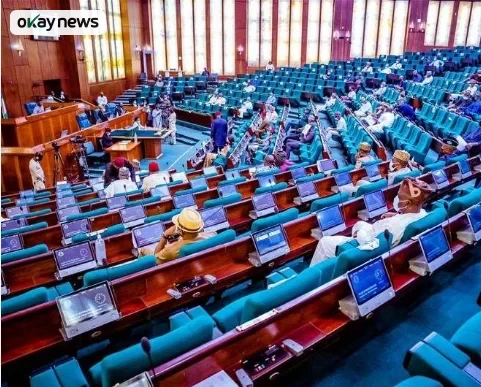
Members of Nigeria’s lower legislative chamber, the House of Representatives, have raised serious concerns over what they described as unauthorized alterations in recently passed tax legislation, warning that the integrity of the lawmaking process may have been compromised.
The alarm was raised during a plenary session held on Wednesday, December 17, 2025, when Abdussamad Dasuki, a federal lawmaker representing a constituency in Nigeria’s northwestern region, formally invoked his legislative privilege to draw attention to discrepancies he claimed to have discovered in the officially published version of the tax laws.
Dasuki told his colleagues that after carefully reviewing the gazetted copy of the tax legislation currently in circulation, he found that several clauses did not align with the harmonized version approved by both chambers of the National Assembly, which consists of the Senate and the House of Representatives.
“I’m here today because my privilege has been breached as a member of this all-important House. Mr Speaker, Honorable colleagues, we passed the tax laws (bills) on this floor. I took my time in the last three days to look at the gazetted copy,” Dasuki said.
He explained that his review extended beyond the lower chamber, as he also examined the official votes and proceedings of the Senate, stressing that both chambers had reached a harmonized agreement on the final text of the legislation.
“I also looked at the votes and proceedings of the House of Representatives, and also went an extra mile to look at the votes and proceedings of the Senate, which were harmonized,” he added.
According to the lawmaker, the content currently presented to the Nigerian public does not reflect what lawmakers debated, voted on, and approved. He described the situation as deeply troubling for democratic accountability and legislative credibility.
“Mister Speaker, Honorable colleagues, what was passed on this floor is not what is gazetted. I’m coming under privilege, because I was here. I gave my vote, and it was counted, and I’m seeing something completely different,” Dasuki stated.
Okay News reports that Dasuki formally called on the Speaker of the House to immediately compare the harmonized legislative documents with the gazetted version now in circulation, in order to identify where the alleged alterations occurred.
“On that note and on this privilege, I call on Mr Speaker to graciously look at what was harmonized and what is in the gazetted copy, what was passed in the House and the Senate,” he said.
The lawmaker further alleged that the disputed version of the tax laws is being publicly promoted through official government channels, including Nigeria’s Ministry of Information, raising additional concerns about transparency.
“You will find out that what is before Nigerians, which is being sold to Nigerians at the Ministry of Information, is not what was passed,” he warned.
Dasuki urged the House to reconvene as a Committee of the Whole, requesting that all relevant legislative documents be presented for a comprehensive review and correction where necessary.
“I plead that all the documents should be brought before the Committee of the Whole so that we can make the relevant amendments,” he said.
He described the situation as a direct violation of Nigeria’s constitutional provisions governing lawmaking, insisting that the House must not overlook what he termed a dangerous precedent.
“This is a breach of the Constitution and our laws, and this should not be taken by this Honorable House,” Dasuki added.
Responding to the concerns, the Speaker of the House of Representatives, Tajudeen Abbas, Nigeria’s presiding officer of the lower chamber, assured lawmakers that the issue would be thoroughly examined in the national interest.
He said the leadership of the House would look into the allegations and take appropriate steps to safeguard the credibility of the legislative process.