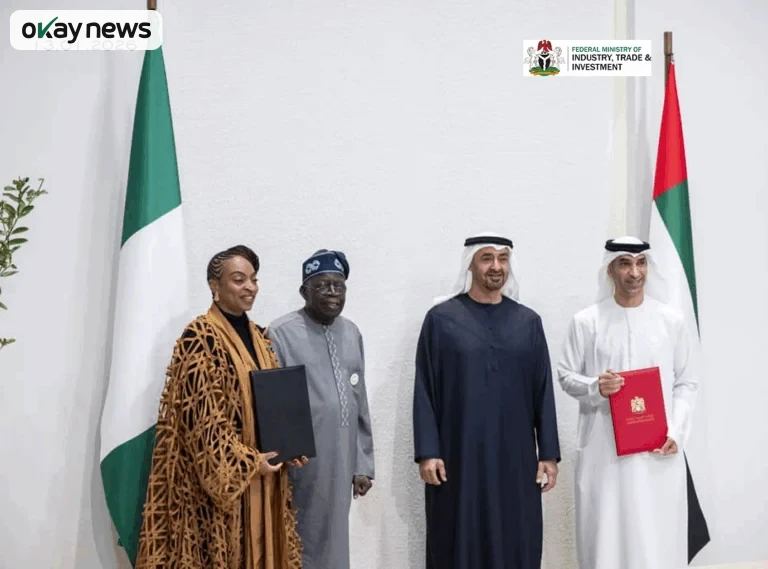
Nigeria’s Federal Government has signed a new trade deal with the United Arab Emirates, a Gulf country in the Middle East, aimed at removing import tariffs on thousands of goods traded between both countries.
The agreement is known as a Comprehensive Economic Partnership Agreement, which is commonly called CEPA. It is designed to reduce the cost of cross-border trade by lowering or removing duties on selected products over time.
A member of the Governing Board of the North East Development Commission, Representative Sam Onuigbo, spoke about the deal on Tuesday in Abuja, Nigeria’s capital, during an interview with the News Agency of Nigeria. Onuigbo is a former member of Nigeria’s House of Representatives, where he represented the Ikwuano and Umuahia North and South Federal Constituency, and he also previously chaired the House Committee on Climate Change during the country’s Eighth National Assembly.
He said the CEPA signed between Nigeria and the United Arab Emirates was a major development announced in Abu Dhabi, the capital of the United Arab Emirates, during Abu Dhabi Sustainability Week, a global sustainability conference held from Saturday, 11 January 2026 to Thursday, 15 January 2026.
According to Onuigbo, the agreement signed in January 2026 will see the United Arab Emirates eliminate tariffs on 7,315 Nigerian products. He explained that 2,805 products will receive immediate duty-free access, representing 38.3 per cent of the total, while tariffs on the remaining items will be phased out over three to five years. He said the coverage includes both agricultural and industrial goods.
Onuigbo also stated that Nigeria, under the same Nigeria and United Arab Emirates CEPA signed in January 2026, has removed tariffs on 6,243 products imported from the United Arab Emirates. He described the arrangement as a significant opening for trade and investment between Nigerians and the Emirati market.
Okay News reports that Onuigbo believes the deal could help legitimate Nigerian business people expand operations into the United Arab Emirates, including setting up offices and taking advantage of short-term work opportunities that allow them to spend up to three months there before returning home.
He praised Nigeria’s President, Bola Ahmed Tinubu, for supporting the agreement, saying it is intended to help reposition Nigeria’s economy, encourage job creation, and improve the overall business environment.
Onuigbo also linked the trade agreement to Nigeria’s broader efforts to close its long-standing energy and electricity gap. He noted that Nigeria, Africa’s most populous country with a population of nearly 250 million people, has often struggled with insufficient power supply, which has limited industrial growth and wider economic targets.
He said the government has been pursuing several policies and reforms to address the issue, including the Energy Transition Plan and the Climate Change Act. He also referenced the Electricity Act, which he said President Tinubu signed about eight days after taking office in 2023, as part of efforts to strengthen the sector and improve access to reliable power.
Onuigbo added that Nigeria’s participation in the Abu Dhabi gathering could support wider global economic cooperation between Nigeria and the United Arab Emirates. He said such partnerships could also contribute to addressing the damaging effects of climate change while supporting Nigeria’s economic plans for 2026.