

Nigeria’s Federal Government has firmly dismissed claims suggesting that there are multiple versions of the newly enacted tax reform laws, insisting that only one authentic version exists and remains in force.
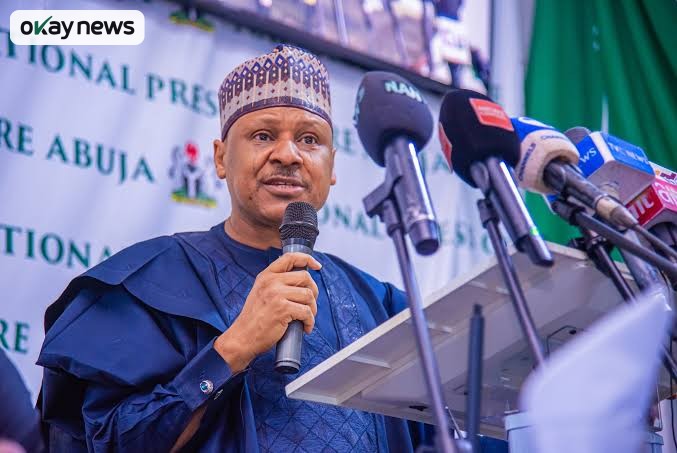
The clarification was given on Monday, at an end of year media briefing held in Abuja, Nigeria’s capital city, by Nigeria’s Minister of Information and National Orientation, Mohammed Idris, who addressed growing public concerns surrounding the credibility of the tax legislation.
According to the Minister, the version of the tax reform laws that received presidential assent from Nigeria’s President, Bola Ahmed Tinubu, is exactly the same as the one passed by Nigeria’s National Assembly, the country’s federal legislature consisting of the Senate and the House of Representatives.
Okay News reports that the clarification followed widespread allegations that certain provisions in the tax laws had been altered after lawmakers approved the bills and before they were officially gazetted for implementation.
Idris stressed that the tax laws went through the full legislative process, including stakeholder consultations, parliamentary debates, and formal approval by both chambers of the National Assembly, before being signed into law by the President.
“The Federal Government is going ahead with the commencement of implementation, noting as changed,” Idris said.
He further explained that questions had been raised by some lawmakers regarding possible discrepancies between the version passed by the legislature and the version later gazetted, noting that the executive arm of government would respect and rely on the outcome of the National Assembly’s internal review process.
“I think it is important for us to wait for the National Assembly to look at this again to tell us whether there were discrepancies or not,” he said.
“This is, at this point, an affair of the National Assembly to which I have no jurisdiction, and I have no authority to speak about. As far as the government of Nigeria is concerned, there’s only one version of that tax document.”
The controversy began after a member of Nigeria’s House of Representatives, Abdussamad Dasuki, who represents the Kebbe and Tambuwal Federal Constituency in Sokoto State, north western Nigeria, raised concerns on the floor of the House about alleged alterations to the tax reform laws.
Dasuki alleged that the version of the laws approved by lawmakers differed from the version later gazetted and circulated by the Federal Government through the Ministry of Information and National Orientation.
The tax reform laws, which are scheduled to take effect on Wednesday, 1 January 2026, were recently signed into law by President Tinubu, following months of legislative deliberations.
However, the bills faced strong resistance during debates at the National Assembly, particularly from some lawmakers from northern Nigeria, who expressed concerns about the potential economic and regional impact of the reforms.
The controversy intensified after Dasuki claimed that some provisions contained in the gazetted laws were never debated or approved by lawmakers during plenary sessions.
Beyond the legislature, the tax reforms have also drawn criticism from prominent Nigerian political figures, including Atiku Abubakar, a former Vice President of Nigeria, and Peter Obi, the Labour Party’s presidential candidate in Nigeria’s 2023 general election. Both men have called for the suspension of the laws’ implementation until all disputed provisions are fully clarified.
Meanwhile, the Chairman of Nigeria’s Presidential Fiscal Policy and Tax Reforms Committee, Taiwo Oyedele, has also rejected claims of secret alterations, warning that failure to implement the tax laws from the scheduled date could have serious consequences for Nigeria’s fiscal stability.